AI Is No Longer Just a Fintech Feature
The previous Monday analysis on how AI is changing fintech distribution, workforce design, systems of record and supervision.
Read More →Dakota, Zaria and Nayax all moved towards regulated banking structures this week, while bunq's attempt to establish a US bank was rejected. The attraction is easy to understand: fewer intermediaries, more control and a larger share of the customer relationship. What the bunq decision makes equally clear is that acquiring the licence is only one part of becoming the institution behind it.

A bank charter can give a fintech greater control over the product and financial infrastructure beneath it, but that control comes with governance, compliance, capital and operational responsibilities of its own.
For much of the fintech era, becoming a bank was something technology companies were supposed to avoid.
The basic argument was compelling. Banks were slow because they carried expensive infrastructure, regulatory obligations, large operational teams and decades of accumulated complexity. A fintech could keep the part customers actually valued - the product - and obtain the regulated capabilities underneath it from someone else. Partner banks held deposits, processors moved money and licensed institutions provided access to the financial system, leaving the fintech free to concentrate on distribution and technology.
That model has not stopped working. In fact, it remains one of the reasons new financial products can be launched far more quickly than they could a generation ago. What is changing is that some companies which originally benefited from separating the product from the regulated infrastructure are now asking whether that separation has gone too far.
The evidence this week was unusually concentrated. Zaria announced an application for a US national trust-bank charter designed around structured finance. Dakota said it had applied for its own national trust charter as it expands its stablecoin and digital-asset infrastructure. Nayax wants to create a non-depository innovation bank in Connecticut so that it can bring card and credit products closer to the payments business it already operates. Then came the counterpoint: the Office of the Comptroller of the Currency rejected bunq's application for a US national bank charter, citing concerns that went well beyond the quality of its app or its success as a European digital bank.
Taken together, these stories are less about fintech companies suddenly wanting to become traditional banks than about something more practical. As financial platforms mature, the institutions and partners sitting underneath them begin to determine how much of the product they can control, how much margin they retain and how easily they can move into the next line of business.
A charter can solve some of those problems. It also brings others inside the company.
Dakota's own explanation of its application is unusually direct. The company currently operates in the United States as a registered Money Services Business and has applied to the OCC for a national trust-bank charter that would position it as a federally regulated provider of digital-asset custody, stablecoin issuance and related services. Its stated rationale is not simply regulatory status; Dakota argues that bringing more of this infrastructure under its own regulated entity would mean fewer intermediaries between its customers' products and the financial services underneath them. (Dakota)
That is an increasingly important distinction.
Partner-based infrastructure is enormously useful when a business is entering a market. Instead of obtaining every permission and building every connection itself, a fintech can assemble the services it needs from licensed providers and concentrate its resources on the part of the proposition where it believes it has an advantage.
The difficulty appears when those providers stop being invisible infrastructure and start shaping the business.
A partner determines which activities it is willing to support. Another controls settlement or custody. A third owns an important compliance process. Commercial terms can change, product development has to accommodate several external roadmaps, and a service that looks seamless to the customer may depend on a surprisingly long chain of institutions behind the scenes.
None of this means the partner model is flawed. It means that its economics change with scale and ambition.
Dakota is building infrastructure for companies that themselves want to move and manage money programmatically. In that context, reducing the number of regulated layers beneath the product is not merely an exercise in vertical integration; it can affect reliability, product design and how quickly a customer can move from an idea to a live financial service. Dakota makes essentially that argument itself, presenting the charter as a way to make what its customers build easier and more reliable.
The interesting part is what happens next. Once the intermediary disappears, the responsibility previously carried by that intermediary does not disappear with it. Dakota would no longer only be orchestrating regulated services supplied elsewhere; for the activities covered by the charter, it would become part of the regulated layer its customers rely upon.
Control and responsibility arrive together.
Zaria's proposed institution makes the changing role of the bank charter even clearer because it looks very little like the bank most customers would recognise.
The company announced on 5 August that it had applied to establish Zaria National Trust Bank, a special-purpose national bank whose activities would be centred on trust-company and related functions. The proposed institution would provide corporate trustee and agency services, loan servicing, collateral management and backup servicing across structured-finance markets, including asset-backed securities, syndicated credit and digital-asset-backed lending. (PR Newswire)
There is no attempt here to build another current account, debit card or consumer neobank.
Zaria is trying to make the regulated institution part of the infrastructure used by lenders and asset managers. Its argument is that functions which are currently fragmented across trustees, servicers, collateral managers and other providers can be brought together inside one federally regulated counterparty, with technology allowing collateral and credit positions to be monitored more continuously.
That is a very different reason to seek a bank charter from the one fintech was discussing ten years ago.
The earlier debate was largely about whether a technology company could become a better bank. The newer question is whether a regulated bank can become one component of a technology product.
For Zaria, the value of the charter is tied to the legal and fiduciary role of the entity itself. The technology may improve how collateral is monitored or information is reported, but the proposition also depends on customers trusting the institution that sits in the middle of those transactions.
This is one reason the current wave of charter applications should not be interpreted as evidence that fintech is simply converging back towards traditional banking. A national trust bank designed around structured finance, a stablecoin infrastructure company seeking federal oversight and a consumer bank taking deposits may all carry the word bank, while their actual operating models have remarkably little in common.
The permission matters because of what it allows the business to do. The label is secondary.
Nayax makes the commercial logic easier to see because it is starting from payments.
On 6 August, the company announced an application to establish Nayax America Bank under Connecticut's Innovation Bank framework. The proposed institution would be non-depository and would not operate branches or offer consumer banking. Instead, Nayax wants to use it to provide corporate cards, controlled-spend programmes and working-capital products such as merchant cash advances and equipment financing to businesses already using its platform. (Nayax)
The important detail is that Nayax does not have to find an entirely new customer base for these products. Payments have already put the company inside the financial life of its merchants.
That position provides something banks and lenders have always valued: visibility into commercial activity. A payments platform can see transaction flows, settlement patterns and how a merchant's business behaves over time. Once the platform has established that relationship, cards, working capital and other financial products become natural extensions of it.
Nayax is already experimenting with this broader role. Alongside the charter application, it launched Yellow Account for US small-business customers, with Adyen acting as the sponsoring bank and holding the deposits. Nayax makes clear that this arrangement is separate from the proposed innovation bank, which would not accept deposits even if the charter is approved.
That makes this a particularly useful example of how modern fintech infrastructure is actually assembled. Own the bank and use a partner are not always opposing strategies.
Nayax can continue using Adyen where a deposit-taking bank is required while attempting to bring other regulated activities onto infrastructure it controls itself. Rather than replacing every partner, it is deciding which parts of the financial relationship are strategically important enough to own.
That is a more mature version of the build-versus-buy decision. The question is no longer whether the company can integrate another provider. It is whether continuing to rely on that provider gives away too much control, too much economics or too much freedom over what gets built next.
Nayax says North America already accounts for approximately 40% of its global revenue, which helps explain why it is prepared to consider a heavier regulatory structure there. At that point, owning more of the infrastructure can become less about prestige and more about protecting the economics of a market that has become central to the business.
The three applications might leave the impression that obtaining a charter has simply become the next stage of fintech expansion. bunq is a useful reminder of why that conclusion would be premature.
Reuters reported on 7 August that the OCC had rejected the Dutch digital bank's application to establish a US national bank. The regulator's denial letter was dated 4 August and referred to significant supervisory and compliance concerns. According to the reporting, the OCC questioned how the proposed US operation would be capitalised, the management team's experience with unsecured credit cards, whether the institution could operate safely and soundly, and whether its business model could become profitable in a highly competitive market.
Euronext / Reuters syndication adds that bunq's own response focused on the need for a plan designed more specifically for the US market, stronger demonstrated experience in the products it intended to offer and more detail around its financial structure.
What makes the decision particularly interesting is that bunq is not a fintech attempting to run a bank for the first time. It is already a licensed European bank.
That experience clearly matters, but it was not enough to answer the questions the OCC was asking about the institution bunq wanted to establish in the United States. The regulator was not evaluating whether bunq had built an attractive European product or whether its existing business had customers. It was assessing a specific proposed US bank with a particular capital structure, management team, product set and route to profitability.
This is the part of international fintech expansion that can get lost when licences are discussed as items on a geographic roadmap.
Regulators do not licence the global brand in the abstract. They licence an entity operating in a particular market. The people running it matter. Its capital matters. The risks of the products it plans to launch matter. So does the credibility of the assumptions showing that it can operate sustainably once the initial funding and enthusiasm have been absorbed.
Experience elsewhere can strengthen the case. It does not remove the need to make it locally.
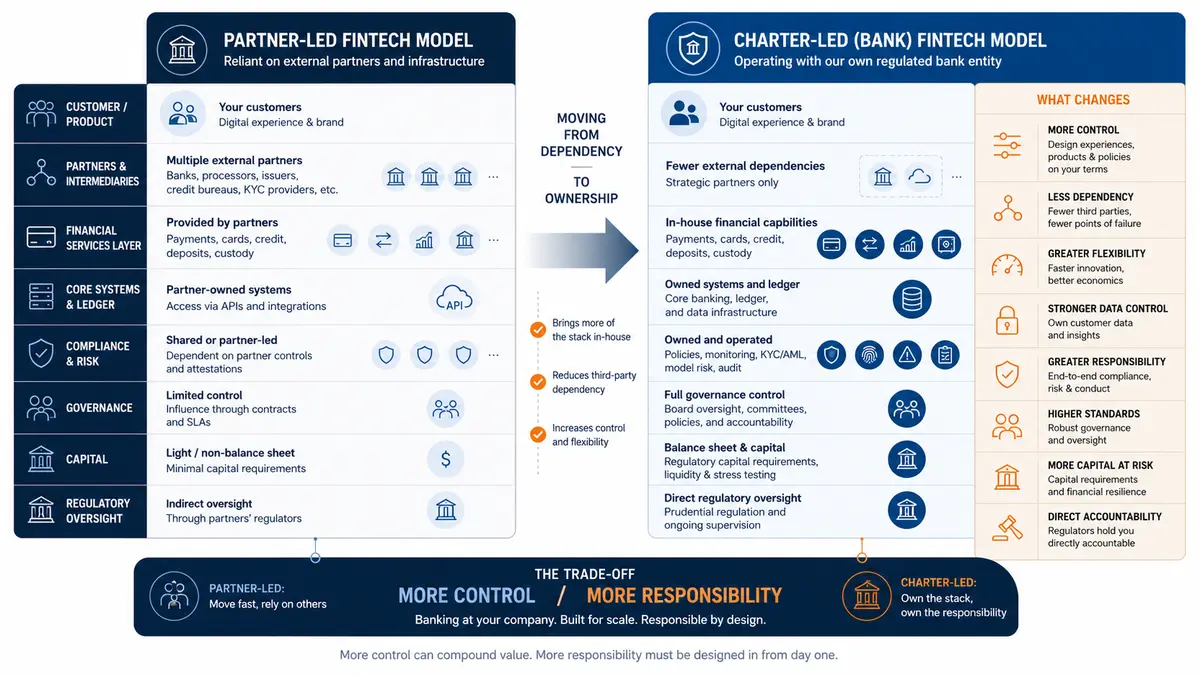
Moving more of the financial stack in-house can reduce dependency on external partners and give a fintech greater control over products, data and economics. It also moves governance, compliance, capital and regulatory accountability inside the organisation.
The obvious explanation for this week's activity is that fintech companies want more control, and that is broadly true. It is also incomplete.
A charter can remove an external institution from part of the value chain, but it does not remove the work that institution was performing. The work moves.
If a partner previously carried responsibility for a regulated activity, the fintech taking that activity in-house now needs the governance, compliance framework, risk management, financial controls and people required to perform it itself. Systems that were previously integrations into somebody else's regulated environment may become part of the company's own books and records.
This is where the licensing conversation very quickly becomes a technology conversation.
The institution needs to know which system holds the authoritative account or transaction record, how financial events are posted and reconciled, who is allowed to override a control and how that intervention is recorded. Regulatory reporting has to reconcile with operational data. Access permissions need to reflect actual responsibilities. When an external processor or banking connection fails, the company still needs to understand the state of the transaction and the balance shown to the customer.
None of those requirements are particularly visible in a licence-application headline, but they are part of what makes the regulated entity real rather than nominal.
The same applies to management. A company may have excellent engineers, an experienced commercial team and a product that has already found its market. A regulator can still reasonably ask whether the people who will run the institution have managed the specific financial risks the proposed products create.
bunq's rejection demonstrates this from the regulatory side. Dakota, Zaria and Nayax demonstrate it from the strategic side. Each sees a reason to bring regulated capability closer to the business, but doing so means building more than the permission itself.
There is a risk that the current wave of charter applications produces the wrong lesson for smaller fintech companies.
Seeing established platforms move towards regulated banking structures can make licence ownership look like a natural mark of maturity: start with partners, grow, then eventually become the regulated institution yourself.
Some businesses will follow exactly that path. Others should not.
A partner can provide expertise and infrastructure that would be expensive to reproduce internally. It can make entry into another market faster and allow the fintech to keep capital focused on distribution or product development. For a company operating across several jurisdictions, maintaining a network of regulated partners may be far more sensible than building separate licensed institutions in every country.
What matters is the reason for wanting more control.
If a partner has become a material constraint on product development, pricing, market access or operational resilience, bringing some capability inside the organisation can be strategically important. Nayax's decision is understandable partly because it already has a large US merchant business into which further financial products can be distributed. Dakota's case is different, but its argument is equally connected to the product: fewer regulated layers underneath the infrastructure it provides to other companies. Zaria goes further still, making the regulated entity itself part of the service it intends to sell.
Those are concrete reasons.
Having our own bank would make us look more credible is not.
A banking structure obtained without a clear strategic need can leave the company carrying additional capital requirements, governance costs and regulatory obligations without producing enough economic value to justify them. The licence expands what the company is permitted to do, but it does not create customer demand or make the new activities profitable.
That is why the most useful decision may sometimes be to own only part of the stack.
Nayax's proposed model illustrates the point particularly well. It wants a regulated institution for certain card and credit activities while leaving customer deposits with Adyen. The result is neither pure outsourcing nor complete vertical integration. It is a deliberate division between capabilities the company wants to control and those it is still comfortable sourcing externally.
That sort of boundary is likely to become more common as fintech models mature.
There is a tendency in fintech to describe licensing as the obstacle that stands between a product and the market.
The business has a plan, the technology is ready, and somewhere in the middle sits a regulatory process that must be completed before everything else can begin.
Bank charters expose the weakness in that way of thinking.
The regulator is interested in capital, management experience, governance, risk, controls and financial viability because those are not administrative details surrounding the bank. They are the bank.
By the time a company is asking for permission to operate one, much of the institution therefore needs to exist already, at least in design. The management structure must make sense, the financial assumptions need to survive scrutiny and the technology has to be capable of supporting the records, controls and reporting that the proposed activity requires.
This week brought three companies arguing that owning more of the regulated layer would improve the businesses they are building, and one regulator saying that an established European digital bank had not yet made a sufficient case for the US institution it wanted to create.
That combination is more useful than another story about fintechs becoming banks.
The interesting question is not whether the industry is moving back towards traditional banking. It is where different companies are deciding to draw the line between the infrastructure they rent and the institution they are prepared to become.
A charter can move that line considerably.
It cannot build the organisation on the other side of it.
This article is not legal advice. It draws on the operational experience of a team that has supported the launch and delivery of more than 100 regulated financial-services businesses.

Fintech This Week is Advapay's Monday analysis series covering developments that change practical decisions for founders and operators building regulated financial businesses.