How to Launch a Fintech Company in 2026
The complete, practical guide to building a regulated fintech globally - from initial business model validation through to post-launch compliance.


Free guides, checklists, and tools for fintech founders building regulated businesses in Europe. Written by the Advapay team, based on 100+ licensing processes, not theory.
The complete, practical guide to building a regulated fintech globally - from initial business model validation through to post-launch compliance.
By Ivan Aleksandrov, Chief Strategy Officer at Advapay · 100+ fintech launches supported
Read More →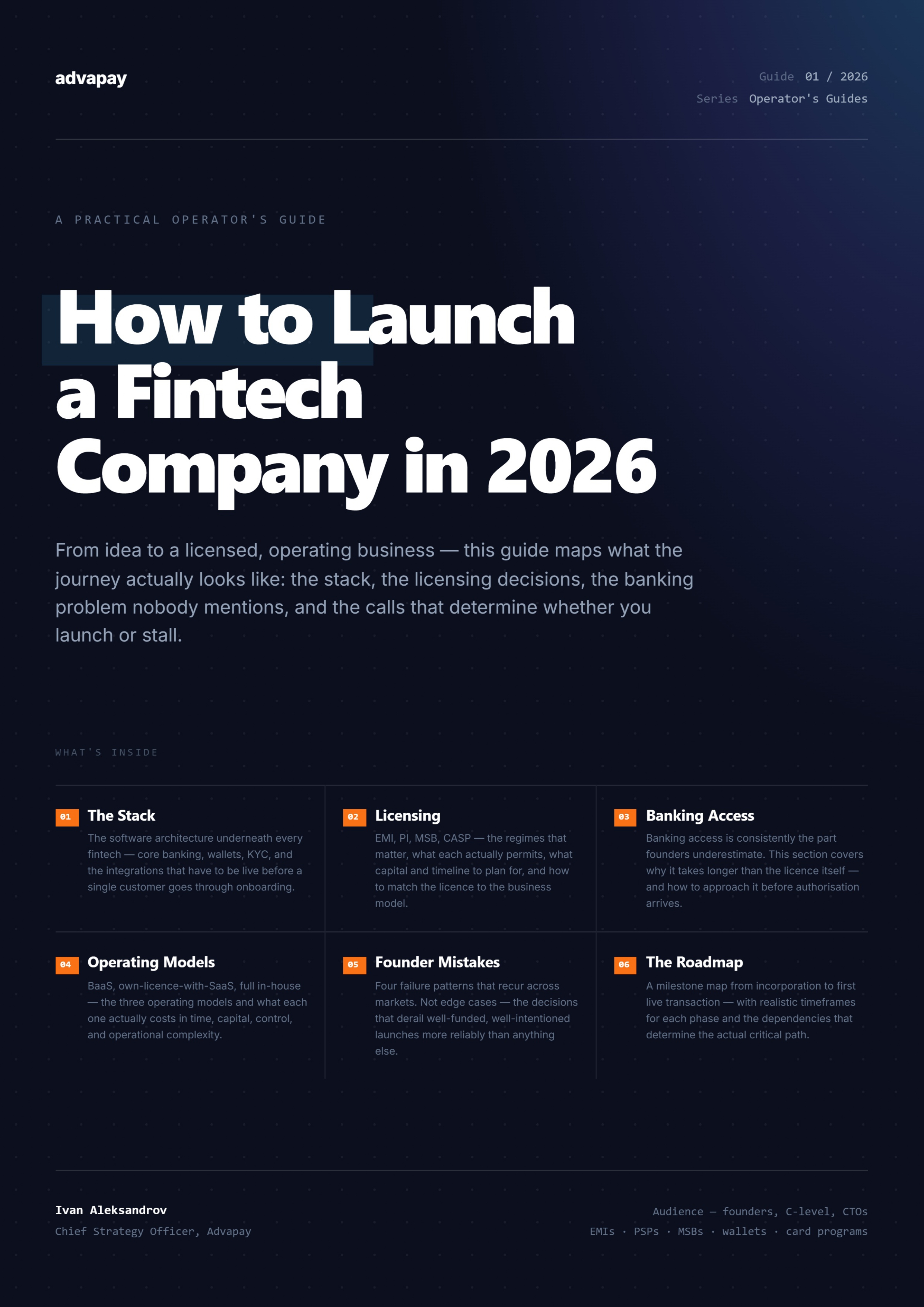
Core banking resources on architecture, platform selection, implementation models, SaaS, licensing, source code, and modern regulated fintech infrastructure.
TopicFintech licensing resources for EMI, PI, CASP, Swiss SRO, jurisdiction selection, regulated market entry, and multi-jurisdiction strategy.
TopicResources on BaaS, IBANs, SEPA, SWIFT, payment rails, safeguarding, stablecoins, and banking access for regulated fintech teams.
TopicFintech strategy resources on market entry, growth markets, operating models, infrastructure sequencing, and regulated fintech execution.
TopicCompliance resources for regulated fintech operators covering DORA, MiCA, AI controls, cybersecurity, operational resilience, audit trails, and risk governance.
Read the Advapay Fintech Trends series on AI, embedded finance, stablecoins, regulation, multi-jurisdiction strategy, growth markets, and cybersecurity.
SeriesRead Advapay Fintech This Week articles on fintech regulation, infrastructure, payments, crypto, AI, market movement, and regulated financial services.
The complete, practical guide to building a regulated fintech globally - from initial business model validation through to post-launch compliance.
A practical guide to the architecture, operating models, responsibilities, costs and provider strategy behind white-label Banking-as-a-Service.
A practical guide to choosing between an EMI license and a PI license based on whether the fintech model stores customer value or only moves money.
Core banking software is the system of record behind every account and payment. Here is what it does in 2026 and what to expect from a modern platform.
A Swiss fintech license and SRO membership are two different permissions. Ivan Aleksandrov explains what each covers, the capital, timeline, and fit.
Dakota, Zaria and Nayax moved towards regulated banking structures while bunq's US charter bid was rejected. Why fintechs want more control - and what comes with it.
A scheduled Fintech Trends 2026 index article by Maxim Ivanchenko bringing together the source outlook plus all seven deep-dive follow-ups on AI, embedded finance, stablecoins, regulation, multi-jurisdiction strategy, growth markets, and cybersecurity.
A Tuesday Tech article by Hamid Najafi explaining why banking access stalls more fintech launches than licensing does, why single-provider dependence is the most underpriced concentration risk, and how fintech teams can de-risk banking access by treating it as a parallel workstream from day one.
A Fintech This Week analysis of how Revolut, Chime and BaFin show AI moving beyond customer-facing fintech features into subscription distribution, workforce design, systems of record, workflow redesign and financial supervision.
The seventh Fintech Trends 2026 deep-dive: Maxim Ivanchenko explains why cybersecurity has become an adaptive systems race across AI-driven attacks, fraud, DORA resilience expectations, third-party risk, access control, API edges, and platform observability.
A Tuesday Tech article by Hamid Najafi explaining how fintechs get IBANs, reach SEPA and SWIFT, choose between direct participation and BaaS partner access, and operate the back-office for multi-IBAN issuance, payment routing, and reconciliation.
Advapay weekly fintech commentary for 20 to 26 July 2026: Visa, Ramp, LemFi and OpenPayd show stablecoins moving into treasury, accounting and cross-border settlement, while agentic payments, virtual cards and licensing developments confirm that control, reconciliation and permissions determine whether new rails can scale.
White-label Banking-as-a-Service combines a branded fintech proposition with core banking technology, compliance controls and regulated financial infrastructure. This guide explains how the model works, what each party is responsible for, how implementation is structured and how to scale without becoming dependent on one provider.
The sixth Fintech Trends 2026 deep-dive: a corridor-by-corridor field guide to Latin America, Canada, Bahrain and the infrastructure choices behind deliberate fintech expansion.
A Tuesday Tech guide by Hamid Najafi explaining how Banking-as-a-Service works, how fintechs use BaaS providers, how responsibilities are divided, and how partner infrastructure connects to core banking technology.
Advapay weekly fintech commentary for 13 to 19 July 2026: Wero merchant distribution, the digital euro pilot, stablecoin treasury and card products, DTCC tokenization, and Revolut's Dubai approval show why regulated operators need infrastructure that can support several rails and licensing regimes at once.
Karlo Soltic explains why licensing, governance, technology selection, safeguarding and banking access should be planned together when launching a regulated fintech in the EEA and beyond.