FrameworkPSD3 / PSR
RegionEU
Why it matters operationallyModernises payment rules, fraud controls, and market structure
Fintech in 2026 is not being defined by brand-new ideas. It is being defined by old ideas becoming operational obligations.
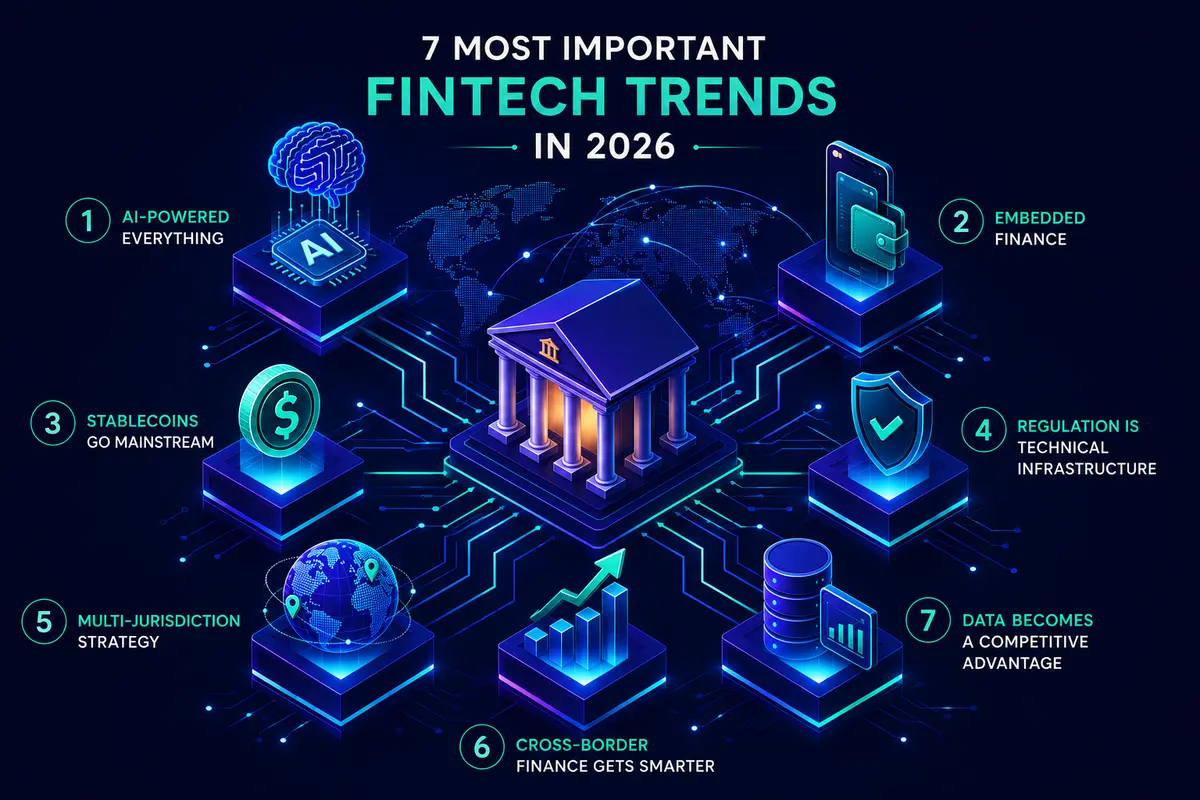
This is not a complete report on everything happening in fintech. It is better read as an operator-focused view of the seven trends that are putting the most pressure on business models, infrastructure choices, and market-entry strategy. For fintech founders, payment institutions, digital banks, and crypto operators, the real story in 2026 is not the headline trend. It is the operating consequence underneath it.
That is the real change. AI is no longer a side tool. Stablecoins are no longer only a crypto-native topic. Regulation is no longer something handled after growth. International expansion no longer means entering one more market and hoping the rest can be solved with partnerships later.
The least interesting version of the AI story is that fintech companies are using more AI. Of course they are. The more useful question is where AI is being allowed to sit inside real financial workflows, and under what controls.
In practice, AI is moving into onboarding review, transaction-monitoring support, reconciliation, internal QA, case triage, documentation handling, fraud detection, and customer operations. The pressure behind that shift is obvious: margins are tighter, compliance expectations are rising, and scaling by headcount alone has become too expensive. But the operational limit is just as obvious. In regulated finance, no serious institution wants a black box inside critical decisions without auditability, escalation logic, and human oversight.
There is a second AI story running in parallel, and it is less comfortable. AI is now helping both defenders and attackers. That means AI in fintech is no longer just an efficiency theme. It is a control-systems theme, and it increasingly overlaps with the broader questions of AML and KYC tooling and operational resilience.
AI in fintech is no longer just an efficiency theme. It is a control-systems theme.
Embedded finance was easier to narrate when the industry was mostly talking about cards, checkout finance, and API-led distribution. The next phase is more strategic and less forgiving.
The better questions now are these: are payments, lending, and investing converging into unified ecosystems, or does specialisation still win? Are super-app models genuinely portable across markets, or are they deeply regional? And how far are traditional banks willing to open their infrastructure beyond payments into treasury, credit, and investment layers?
That is why 2026 looks less like a BaaS hype cycle and more like an operating-model debate. Payroll platforms are adding treasury functions. SaaS platforms keep pulling payment flows inside their products. E-commerce and platform finance continue to blur the line between software and credit. India is a useful reminder here: much of what gets described as neobanking still runs through partner-bank structures rather than standalone digital-bank licences.
For firms thinking about product design and distribution, the more useful frame is not hype but architecture. Advapay’s own breakdown of embedded finance, embedded payments, and BaaS is a good example of why these models need to be separated before they are scaled.
Stablecoins still attract ideological arguments, but for operators the interesting question is much narrower: where do they solve a real infrastructure problem better than existing rails?
For cross-border treasury movement, merchant settlement, internal liquidity routing, and certain payout corridors, stablecoins are increasingly part of that discussion. The European Commission explicitly notes that crypto-assets can support cheaper, faster, and more efficient payments, especially cross-border. What changed the tone in Europe is not enthusiasm alone, but regulatory structure.
With MiCA now in force as the EU framework for crypto-assets, stablecoins and related crypto services have moved into a formal perimeter of authorisation, prudential expectations, governance, and compliance. That does not mean every fintech should bolt stablecoins onto its stack. It does mean they can no longer be dismissed as a fringe payments topic.
For operators considering crypto-fiat infrastructure, this is where practical questions matter more than slogans: custody setup, wallet design, transaction monitoring, accounting treatment, and licensing scope. Advapay’s own MiCA guide for businesses is useful here because it treats MiCA as an operating framework rather than a branding exercise.
It is no longer enough to say that regulation is getting stricter. The more useful observation is that regulation is becoming more operational, more structured, and more data-dependent.
In the EU, the payments framework is still moving toward the next stage through the European Commission’s PSD3 and PSR package. At the same time, DORA has pushed digital operational resilience into the center of financial-sector governance, especially around incident response, recovery, ICT oversight, and third-party risk.
In the UK, the FCA’s PS26/2 policy statement has already established a single reporting regime for operational incidents and material third-party arrangements, with application from 18 March 2027. That matters because it confirms the direction of travel: supervisors increasingly want structured reporting, comparable data, and clearer oversight of outsourced dependencies.
The implication is straightforward. Governance itself is becoming technical infrastructure. Once reporting, outsourcing oversight, and resilience obligations become this structured, disconnected spreadsheets and ad hoc control mapping stop being enough for ambitious firms.
That is also why articles such as Advapay’s explainers on PSD3 and PSR and what is changing from PSD2 to PSD3/PSR are commercially relevant, not just educational. They point to the same strategic truth: regulatory change now directly affects product architecture, reporting models, and partner strategy.
| Framework | Region | Why it matters operationally |
|---|---|---|
| PSD3 / PSR | EU | Modernises payment rules, fraud controls, and market structure |
| DORA | EU | Pushes resilience, incident management, and ICT oversight into the core operating model |
| PS26/2 | UK | Standardises operational-incident and third-party reporting |
| MiCA | EU | Turns crypto activity into a licensable, supervised infrastructure question |
This is a simplified executive view of the current regulatory direction, not a substitute for legal analysis.
A few years ago, a fintech could often get quite far with one licence, one bank sponsor, and a loose idea of future expansion. That model is becoming harder to defend.
What serious operators increasingly need is regulatory architecture: where to anchor, where to duplicate capabilities, how to reduce dependence on one partner or one jurisdiction, and how to build a stack that can support payments, onboarding, reconciliation, reporting, and customer operations across markets without becoming unmanageable.
The real differentiator is no longer just access to a licence. It is the ability to turn licensing into a workable operating model. That is especially true in payments, digital banking, and crypto infrastructure, where the legal perimeter and the product architecture are tightly connected.
For companies trying to decide whether to build, buy, partner, or license, this is where fintech licensing services in Europe and core banking infrastructure stop being separate conversations. In 2026, multi-jurisdiction growth is less a badge of ambition than a hedge against concentration risk.
Saying that Africa and Latin America are important fintech growth regions is true, but no longer very informative. The more useful question is what kind of fintech growth is happening, under which regulatory conditions, and in which countries.
Sub-Saharan Africa remains the centre of mobile money, with GSMA reporting 1.1 billion registered accounts in 2024. But the capital story is still concentrated, and not every market converts scale into durable fintech economics.
Latin America has a different dynamic. The strongest signal is not generic fintech adoption, but the scale of fast payments, open finance development, and country-by-country licensing reform. Southeast Asia also deserves to be treated as a first-order fintech region, not as a side note after Africa and LatAm.
The region story now is about multiple regulatory experiments happening at once, each with different implications for platform finance and digital banking. For a practical example, Advapay’s analysis of launching a fintech company or neobank in Latin America is useful because it looks at licensing, payment rails, and local market structure together, rather than reducing the region to growth headlines.
| Region | Main fintech driver | What operators should really watch |
|---|---|---|
| Africa | Mobile money maturity, cross-border payments, selective expansion beyond the top hubs | fraud economics, licensing quality, bank openness, and whether secondary markets keep institutionalising |
| Latin America | Fast payments, digital payments scale, alternative credit layers | FX volatility, monetisation discipline, and credit underwriting quality |
| Southeast Asia | Super-app ecosystems, virtual banks, partnership-led digital banking | fragmented regulation, licensing timing, and how much infrastructure incumbents are willing to open |
Cybersecurity in fintech used to be discussed as a defensive necessity. It is now a strategic race.
Attackers are using better automation, synthetic identities, and increasingly believable impersonation tactics. Defenders are also using more automation, more decisioning, and more adaptive fraud tooling. That means the fraud problem is becoming less about whether a firm has controls at all, and more about whether those controls can evolve as quickly as the attack surface.
The quantum-resilience conversation belongs here, but in the right proportion. It is not yet the main daily problem for most fintech operators. It is, however, moving out of the purely theoretical bucket. NIST finalised its first three post-quantum cryptography standards in August 2024, and its broader migration work is now focused on identifying vulnerable algorithms and helping organisations build transition roadmaps.
That does not make post-quantum migration an immediate board priority for every fintech. But it does mean cybersecurity strategy is widening. Over time, the firms that handle security best will be the ones that treat resilience, cryptographic agility, vendor dependence, fraud tooling, and AI governance as parts of the same operating system.
The defining feature of fintech in 2026 is not disruption. It is operational seriousness.
The sector is still innovative, but the market is rewarding a different kind of company now: one that can combine product speed with regulatory structure, regional ambition with local realism, and AI adoption with actual control. That is why these seven themes belong together. They are not separate headlines. They are different expressions of the same industry shift.
And that is also why this article should be treated as an opening move. Each of these trends deserves a deeper article of its own, not because the themes are fashionable, but because the execution details are where fintech winners and losers are increasingly separated.