Fintech This Week - week of 20 July 2026
Europe's payment rails get real, stablecoins reach card networks and tokenisation moves into the back office.
Read more →Visa, Ramp, LemFi and OpenPayd are moving stablecoins into treasury, accounting and cross-border settlement. What matters most about these launches is not the token itself, but the operational infrastructure being built around it.
Stablecoins are beginning to disappear inside the products built on top of them.
Visa has launched infrastructure that allows financial institutions and fintech companies to issue and manage stablecoins. Ramp has placed stablecoin balances and payments inside familiar business-finance workflows. LemFi, meanwhile, is using stablecoins for cross-border settlement without asking customers to hold crypto or interact with a blockchain.
The important shift is not simply that more companies are adopting stablecoins. It is that stablecoin activity is increasingly being surrounded by the controls businesses already expect around conventional money: permissions, approvals, audit trails, accounting treatment, reconciliation and regulatory oversight.
Moving value across a new rail is becoming the easier part. Making that rail behave like dependable financial infrastructure is where the harder work begins.

Stablecoins are moving into mainstream financial workflows, where control and reconciliation matter as much as the settlement rail.
On 20 July, The Paypers reported on Visa's introduction of the Visa Stablecoin Platform, an enterprise environment through which financial institutions, fintech companies and crypto-native businesses can mint, burn, manage and transfer stablecoins, initially using Open USD.
The details of the platform are more revealing than the announcement itself. It includes wallet infrastructure, bank-account connectivity, dual-control approvals, audit logs, secure passkeys and transfer allow lists. Visa is not presenting stablecoins as an isolated crypto product. It is placing them inside an institutional operating environment with defined permissions, oversight and traceability. (Visa; The Paypers)
Two days later, Ramp launched stablecoin accounts and payments for businesses. Its customers can hold stablecoin balances, pay vendors and reconcile transactions within the finance and accounting systems they already use. (PR Newswire; The Paypers)
The two companies are approaching the market from different directions, but they are solving a similar problem. Stablecoins become more useful when they no longer require a separate operational world around them.
Finance teams do not want another asset that sits outside their treasury controls, approval processes and accounting systems. They want access to a potentially faster and more flexible settlement rail without abandoning the discipline that surrounds conventional business payments.
That is why the next stage of stablecoin adoption is likely to be less about wallet connectivity and more about everything around the wallet. How will balances be represented in the ledger? Who can initiate and approve transactions? Which wallets and counterparties are permitted? How will sanctions controls apply? What happens when an on-chain transaction and the internal account record do not match?
The stablecoin is only one component of the product. The commercially important layer is the one that governs it.
In implementation projects, wallet connectivity is rarely the most difficult part. The harder work is ensuring that the external transaction, the customer ledger and the provider's settlement records remain aligned when something is delayed, rejected, reversed or processed incorrectly.
That is where a crypto and fiat wallet stack has to meet the realities of finance, compliance and day-to-day operations.
The same pattern is becoming visible in cross-border payments.
On 24 July, LemFi partnered with BVNK to move part of its cross-border settlement onto regulated stablecoin payment infrastructure. Its customers do not need to hold crypto balances, select a blockchain or interact directly with stablecoins. The technology operates beneath the existing customer experience, with local currency paid out at the destination. (The Paypers)
On the same day, OpenPayd joined the Fireblocks Network for Payments. The integration gives more than 2,400 participants in the Fireblocks ecosystem access to OpenPayd's fiat infrastructure, initially covering GBP, EUR and USD. It brings together fiat rails, on- and off-ramp access, foreign exchange, remittance functions, wallet verification and Travel Rule compliance. (The Paypers)
This is a more mature version of the stablecoin story than the one usually told.
The customer may never see a token. They may pay in one local currency while the provider uses a stablecoin for settlement somewhere in the middle of the transaction. The recipient still receives ordinary fiat money at the other end.
From the user's perspective, the relevant questions are simple: did the money arrive quickly, was the cost reasonable and did the service work reliably?
The complexity sits underneath that apparently straightforward journey. Someone still has to manage liquidity, fiat access, wallet verification, sanctions screening, treasury exposure, local payout and reconciliation. If those components do not work together, the efficiency of the underlying rail becomes largely irrelevant.
The most interesting operators are therefore no longer leading with the fact that they "use crypto". Stablecoins are becoming one infrastructure option among several, selected because they can improve a particular settlement flow while leaving the customer experience and compliance model intact.
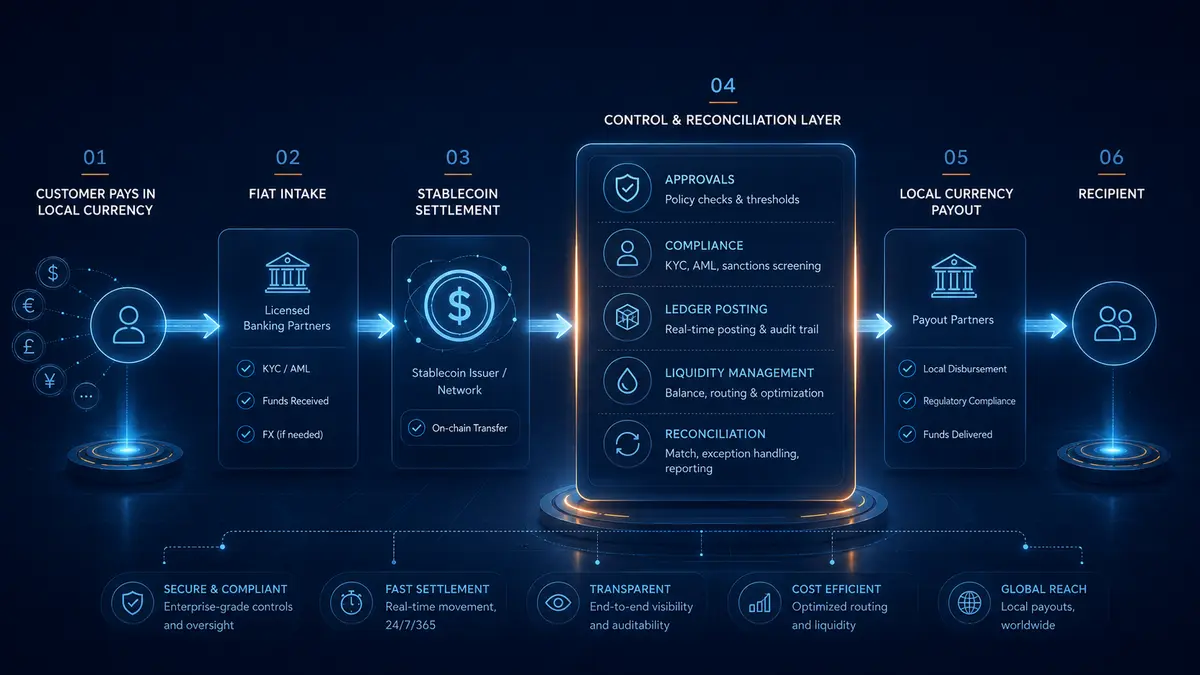
The customer may never interact with a stablecoin. The asset can operate inside the settlement layer while the user pays and receives ordinary fiat currency.
This is why payment infrastructure and ledger design matter as much as the settlement rail itself.
A payment rail determines how value moves. It does not determine whether the resulting product can be operated safely at scale.
A serious stablecoin proposition still needs to answer a number of unglamorous but essential questions. Who is allowed to initiate a transaction? When is a second approval required? Which countries, wallets and counterparties are permitted? How are transaction limits applied? What happens when the blockchain transaction succeeds but the internal ledger does not update correctly? Who investigates reconciliation breaks, and what evidence is available to compliance and audit teams?
These are not secondary implementation details that can be dealt with after launch. Together, they form the operating model.
A fintech may have access to an efficient settlement rail and still struggle to use it in production if the surrounding infrastructure cannot enforce permissions, reconcile balances or produce a dependable audit trail.
That should also influence how founders evaluate providers. Chain support, available tokens and transaction speed matter, but they are only part of the assessment. Ledger integration, wallet governance, approval workflows, fiat entry and exit, sanctions controls, reporting and responsibility for operational failures are equally important.
In practice, the best infrastructure may not be the one that supports the greatest number of blockchains. It may be the one that creates the fewest exceptions and requires the least manual intervention.
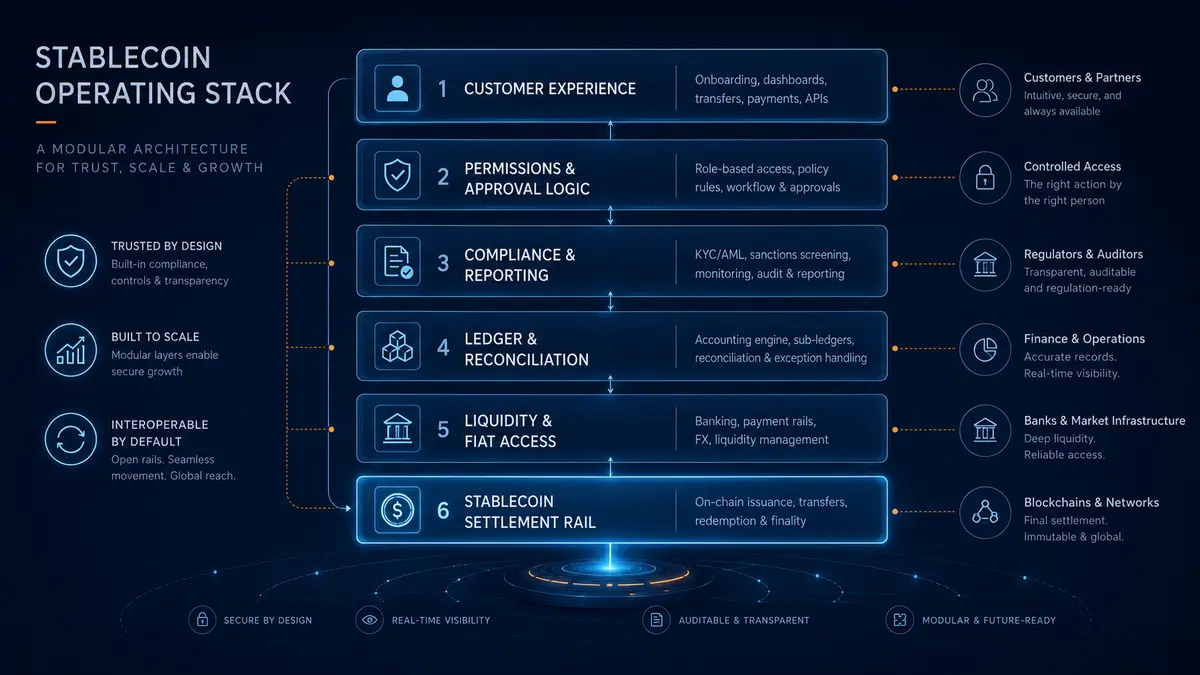
A stablecoin product depends on more than the settlement asset. The operating stack must connect liquidity, ledgering, controls, compliance and the customer experience.
Not all of this week's control stories involved stablecoins.
Visa and Lianlian DigiTech completed what they described as the first live B2B agentic transaction using LoopXPay, Lianlian's AI agent. The agent identified a purchasing requirement, compared suppliers, placed the order and executed the payment within predefined spending limits and approval parameters established by the business.
Visa's Trusted Agent Protocol and Agentic Directory support the model by helping businesses and merchants identify verified AI agents operating within the payments ecosystem. (The Paypers)
Mastercard also announced updates to its In Control virtual-card platform, with Citi named as the first adopter. The changes include issuer-enforced limits, transaction caps, validity periods, clearing-stage controls and centralised policy management. (The Paypers)
These are different products, but the underlying lesson is similar. Automation only scales when authority and control scale with it.
An AI agent may be capable of selecting a supplier and executing a payment, but someone still needs to determine what it may buy, which suppliers it may use, how much it may spend and when human approval is required.
A virtual card may be embedded into procurement or accounts payable, but its limits, validity rules and exceptions still have to be managed throughout the payment lifecycle.
The payment may be embedded, but the controls have to be embedded as well.
A fintech that automates execution without automating policy, monitoring and reconciliation has solved only the easier half of the problem. The rest belongs inside a flexible core banking platform, not in spreadsheets and manual exception queues.
Two regulatory developments from the same week are a useful reminder that infrastructure never operates separately from licensing.
BitPay's European subsidiary received authorisation as a crypto-asset service provider under MiCA from the Dutch Authority for the Financial Markets. The authorisation gives the company a regulated basis for offering crypto-payment acceptance, stablecoin-denominated payments and related cross-border services across the European Union. (The Paypers)
Wise, meanwhile, confirmed that the US Office of the Comptroller of the Currency had rejected its application for a national trust bank licence. Wise said the decision would not affect its existing US operations and that it intended to submit another application. The company continues to operate through licences covering 48 states and four territories. (The Paypers)
One company secured an authorisation that may simplify its position across the European market. The other did not obtain the federal structure that could have reduced some of the complexity of its US operating model.
The conclusion is not that every company should pursue the broadest licence available. A heavier regulatory route may be inappropriate for the stage, resources or ambitions of the business.
The more important point is that licensing is a strategic design decision rather than an administrative formality.
A state-by-state structure, an EU passport, a trust-bank charter, a CASP authorisation and an EMI or PI licence each create different conditions around products, geography, compliance, cost and control.
The licence is not the finish line. It defines the shape of the business that can be operated afterwards.
The first practical lesson is to define authority before automating execution. Every important payment flow should make clear who can initiate, approve, amend, cancel and review a transaction. That remains true whether the actor is an employee, a treasury user, an AI agent, a wallet signer, a virtual card or an automated rule.
The second is to design reconciliation before launch. Blockchain records, provider balances, fiat settlement accounts, customer ledgers, fees and accounting entries all need to connect. It should also be clear who investigates mismatches, what evidence is retained and how unresolved exceptions are managed.
The third is to treat the regulated provider as part of the architecture rather than as a separate commercial relationship. Customer onboarding, sanctions monitoring, safeguarding, settlement, wallet screening, reporting, complaints and incident management all need to be assigned to specific parties and reflected in both the technical and contractual structure.
Finally, the licensing model should be assessed against the future product roadmap, not only against the shortest route to market. A structure that works for one country, one currency and one product may become restrictive once the business adds cards, stablecoins, new customer types or additional jurisdictions.
The fastest operating model to launch is not always the easiest one to scale.
Stablecoins will not become mainstream business infrastructure simply because they are faster, programmable or available around the clock.
They will become mainstream where companies can govern them, reconcile them and operate them more effectively than the systems they are expected to replace.
The same principle applies to agentic payments, virtual cards and embedded finance. Automation makes the rail more useful, but it also makes authority, policy and oversight more important.
The next competitive advantage is therefore unlikely to come from adding one more token, wallet or payment method. It will come from building a control layer that continues to work when transaction volumes increase, products become more complicated and regulators begin asking difficult questions.
This article does not constitute legal advice. It reflects the operational perspective of a team that has helped launch and support more than 100 regulated financial businesses.

Fintech This Week is Advapay's Monday analysis series covering developments that change practical decisions for founders and operators building regulated financial businesses.