

Macrobank core banking software
Macrobank Core Banking Software for Fintechs and Payment Institutions
Launch a new fintech or modernise an existing platform on a configurable operating core for accounts, ledger and accounting, payments, fees, reporting, back-office workflows and customer channels.
Macrobank is built for payment institutions, electronic money institutions, PSPs, neobanks and related fintech models. Choose a vendor-operated SaaS service, a perpetual software licence in a customer-controlled environment, or source-code ownership. Then connect the banks, payment rails, card, foreign-exchange and compliance providers your proposition requires.
Tell us your target market, licence model, customer type, currencies, payment rails and required providers. We will tailor the discussion to your operating model.
Core banking software built for your operating model
The right core banking platform should fit the business you intend to operate—not force the business into a generic demo. Macrobank gives founders and technology leaders a configurable foundation that can support a greenfield launch, an extension into a new product or market, or the replacement of a legacy core. The scope is agreed around the customers you will serve, the accounts and currencies you will offer, the payment flows you must control, the providers you will connect and the operational evidence your team needs.
For a founder launching a regulated fintech, that means avoiding a multi-year internal build of ledger, accounting, permissions, payment orchestration and back-office infrastructure before the customer proposition can go live. For a CTO replacing a legacy platform, it means defining the future operating model first, mapping data and integrations, and selecting the ownership model that gives the organisation the right balance of control and delivery responsibility.
Greenfield fintech
Configure the operating core while licensing, banking access, provider onboarding and product preparation progress in parallel.
EMI, PI or PSP
Run account, ledger, payment, fee, reporting and reconciliation workflows with clear regulated-entity and provider responsibilities.
Neobank proposition
Combine the operating core with branded web or mobile channels and the external services required by the product.
Legacy replacement
Move towards a modern core through a planned fit-gap, data, integration, testing and cutover programme.
Multi-product platform
Use configurable products, tariffs, limits, permissions and workflows to support distinct propositions on one controlled foundation.
Technology-led operator
Choose customer-controlled deployment or source-code ownership when infrastructure, release and engineering control are strategic.
Macrobank is not a substitute for a licence, a sponsor bank, scheme membership, safeguarding arrangements, a card processor, a KYC decision or a compliance function. It is the software layer that records and controls the institution’s products and operations while integrating the external services allocated to those providers. If the requirement is only a consumer interface or a single payment connector, a full core may be more infrastructure than the project needs. If the business requires controlled accounts, balances, ledger entries, fees, payments and operational workflows, a core becomes central.
What Macrobank core banking software includes
Macrobank combines the stable operating core, the tools used by staff, customer-facing channels and provider integrations in one configurable platform. Exact scope depends on the delivery model and agreed project package. The distinction between base platform capability, optional modules and external services is important: it shows what Macrobank records and controls, what can be added, and what still depends on a bank, processor or specialist provider.
The operating core
The operating core holds the controlled customer, account, balance and transaction record. It supports customer and business profiles, account and IBAN structures, multi-currency products, transaction posting, payment and transfer workflows, foreign-exchange configuration, tariffs, fees and limits. Double-entry financial accounting and general-ledger functions provide the internal record needed for financial control, while reconciliation and reporting help operators compare that record with banks, payment providers and other external positions.
Product rules can be configured around the institution’s proposition. That includes account types, currencies, fee schedules, transaction restrictions, approval rules and user permissions. Configuration does not remove the need for product and compliance decisions; it turns those decisions into controlled system behaviour that can be tested, operated and audited.
Customer channels and back-office operations
Macrobank can include branded web and mobile channels for customers and a back-office environment for administrators and operators. Customer channels present the products and services supported by the core: onboarding journeys, account information, beneficiaries, transfers, statements and related actions. The back office supports the teams responsible for customer administration, transactions, exceptions, reporting, reconciliation and system configuration.

Roles and permissions should reflect who may view information, approve an action, release a payment, change a rule or investigate an exception. The channel never becomes an independent source of truth; it reads from and sends instructions to the controlled operating core.

Optional cards and crypto modules
The optional cards module supports the operational card lifecycle: physical or virtual card ordering, activation, block and unblock, closure, renewal and replacement, transaction and authorisation history, account funding movements, statements and reconciliation. Macrobank coordinates the customer and operator workflows and connects to the selected issuer and processor. The issuer, processor and card scheme still perform the regulated and technical functions allocated to them; Macrobank should not be described as a card processor or scheme member.
The optional crypto-fiat module can support wallet and account workflows, fiat and digital-asset views, transaction records and integrations with custody, blockchain and KYT providers. The precise custody model, asset support, transaction execution and compliance controls depend on the legal structure and selected external providers.
External services and integrations
Macrobank connects to the services that complete the operating model: banks and payment rails, card issuers and processors, KYC/KYB and screening services, FX and liquidity providers, messaging tools, data services and other specialist systems. Advapay maintains a broad catalogue of prebuilt integrations and can scope additional connections where the project requires them. Availability and fit must be confirmed against the current integration inventory, provider version, geography and contracted service.
| Capability | Macrobank role | Scope label | What still depends on |
|---|---|---|---|
| Customers, products, accounts and IBAN structures | Maintains customer and account records, product rules and account status | Base / configurable | Business model, permissions, banking access and product approval |
| Ledger, accounting and reconciliation | Posts and preserves double-entry records, internal positions and reconciliation data | Base / configurable | Chart of accounts, accounting policy and external statements or files |
| Payments, transfers, currencies and FX | Controls workflows, postings, fees, limits, instructions and statuses | Base + integrated | Connected banks, rails, FX/liquidity providers and contractual reach |
| KYC/KYB, AML, screening and transaction monitoring | Orchestrates provider calls, stores results and supports operator workflows | Integrated / configurable | Specialist provider, internal decisions, policy and legal responsibility |
| Cards | Manages card lifecycle and account-side workflows | Optional module | Issuer, processor, scheme relationships and programme rules |
| Web and mobile channels | Presents products and controlled actions to customers | Package dependent | Brand, UX scope, app-store process and underlying APIs/providers |
| Crypto-fiat operations | Supports configured wallet/account workflows and records | Optional module + integrations | Custody, blockchain, execution, KYT and legal model |
| Back office, reporting and audit history | Supports staff workflows, permissions, exceptions, reports and traceability | Base / configurable | Operating procedures, role design, evidence needs and management controls |
The matrix describes technology scope, not regulatory sufficiency. Final modules, responsibilities and providers are confirmed during discovery and fit-gap analysis.
How Macrobank fits between your product and providers
Macrobank acts as the controlled operating and ledger layer between customer or operator channels and the external providers that deliver banking, payment, card, identity, FX or digital-asset services. This boundary prevents the customer app, a payment connector or an external provider status from becoming the institution’s only financial record.
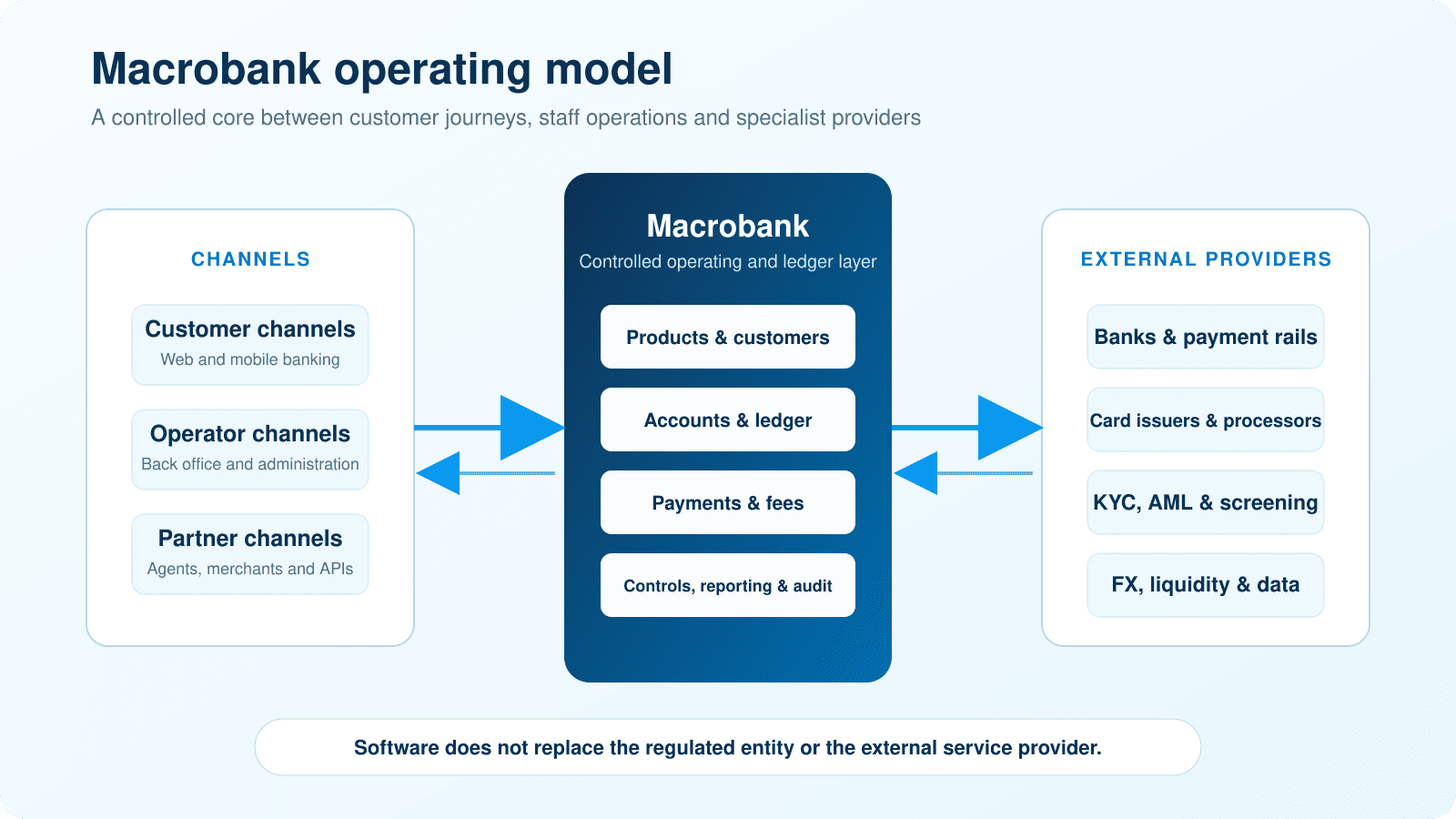
A customer may open an account in a branded web or mobile interface. Macrobank applies the configured product, customer and permission rules, creates the corresponding records and coordinates required provider checks. When a payment is initiated, the platform validates the instruction, applies relevant fees or limits, sends the message through the selected bank or rail adapter, records the evolving status and preserves the internal postings needed for reconciliation.
The external provider remains responsible for the service it performs. A KYC service returns identity or screening results; the regulated institution remains responsible for its policy and acceptance decision. A bank or payment rail transports or settles the payment; Macrobank records, controls and reconciles the institution’s position. A card processor handles processing and scheme connectivity; Macrobank manages the account-side and operational lifecycle agreed in scope.
This layered model also clarifies the difference between core banking software and Banking-as-a-Service. Macrobank is software. BaaS supplies regulated or financial capabilities through a provider relationship. A fintech may use both, but the contract, permissions, infrastructure and risk ownership must remain explicit.
Choose SaaS, a software licence or source-code ownership
Macrobank can be delivered in three ways so the buyer can choose how much infrastructure, release and engineering responsibility to own. SaaS usually offers the fastest route for a standard scope because Advapay operates the platform service within the agreed contract. A perpetual licence gives the customer greater control of its environment while retaining vendor software and support. Source-code ownership adds the ability—and the responsibility—to maintain and change the platform independently.
| Decision factor | SaaS | Customer-controlled licence | Source-code ownership |
|---|---|---|---|
| Infrastructure operator | Primarily Advapay, within contract | Customer or appointed operator | Customer |
| Initial delivery effort | Usually lowest for a standard settled scope | More environment, deployment and coordination work | Highest handover and engineering setup |
| Release control | Shared through vendor release model | Greater customer control | Full customer control |
| Customisation | Configuration and scoped development | Configuration and scoped development | Configuration plus independent code changes |
| Upgrades | Vendor-led under service model | Coordinated; customer environment must be maintained | Customer owns merging, testing and release |
| Internal capability | Product, operations, security and vendor management | Adds infrastructure and deployment capability | Adds permanent platform engineering capability |
| Main cost drivers | Environments, modules, usage, integrations and support | Licence, infrastructure, integrations, upgrades and support | Acquisition, handover, engineering team, infrastructure and maintenance |
Choose SaaS when time-to-market and a managed operating model matter more than direct infrastructure control. Choose a perpetual licence when the institution or its technology partner needs to operate the environment but does not want to rebuild the platform. Choose source code when independent engineering control is strategically necessary and the organisation is prepared to own security, release, merge, test, support and long-term maintenance responsibilities.
The best choice depends on the target jurisdiction, outsourcing approach, internal capability, customisation needs, exit requirements and economics over several years. Compare the models in the commercial SaaS and software-licence guide and the editorial SaaS vs licence vs source-code framework. Exact pricing is not published because environments, modules, integrations, migration and support materially change the scope.
Implementation, integrations and go-live
A Macrobank implementation is a configuration-and-integration programme with defined operational acceptance—not a software installation followed by an improvised launch. Advapay begins by clarifying the product, licence or regulatory route, customers, currencies, payment flows, providers, reporting needs, delivery model and existing systems. That creates a fit-gap view: what the standard platform already supports, what requires configuration, what needs an integration and what genuinely needs additional development.
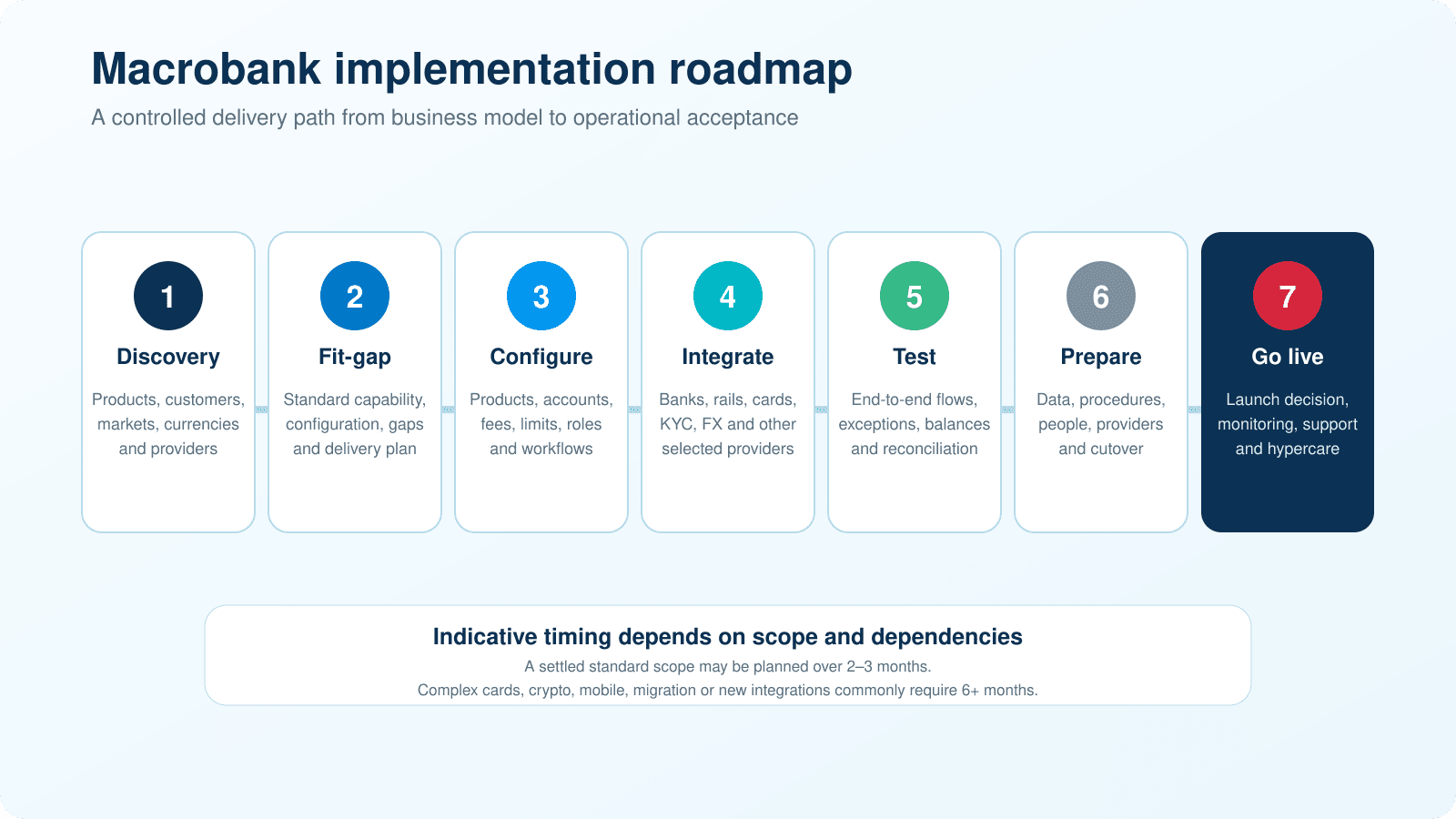
1. Discovery and fit-gap
The project team translates the business proposition into testable platform requirements. This includes customer types, account products, currencies, fees, limits, approval rules, user roles, reports, reconciliation, provider messages and exception scenarios. For a replacement, discovery also covers the current data model, historical records, integrations, operational pain points and cutover constraints.
2. Configuration and integration
Advapay configures agreed products and workflows and connects the providers included in scope. A prebuilt adapter can reduce delivery effort, but the current provider API, credentials, test environment, commercial agreement and required message set still need validation. Custom connections are scoped against documented APIs, error handling, retries, status mapping, reconciliation and operational support.
3. Testing and operational readiness
Testing should cover happy paths and exceptions: customer acceptance or rejection, account changes, fees, limits, payments, reversals, duplicate messages, timeouts, provider failures, balance and ledger reconciliation, permissions, reports and audit history. The client’s product, operations, compliance, finance and technology owners confirm that the service behaves as intended and that staff know how to handle exceptions.
4. Migration, cutover and go-live
A greenfield project may have little historical data but still needs production provider access, operational procedures and readiness checks. A replacement requires mapping, cleansing, trial migrations, reconciliation, rollback planning and evidence that balances and critical history are preserved. A staged migration can reduce risk where products, customer groups or integrations can move separately.
| Workstream | Advapay typically leads | The client must provide or decide |
|---|---|---|
| Product and scope | Fit-gap, configuration design and delivery plan | Clear proposition, priorities, target markets and acceptance decisions |
| Providers and integrations | Adapter configuration, scoped integration work and technical coordination | Selected providers, contracts, access, credentials, documentation and contacts |
| Platform delivery | Configured software, environments within scope, releases and technical support | Timely requirements, approvals, security/infrastructure input where applicable |
| Testing | System support, defect resolution and delivery evidence | Business scenarios, UAT ownership, operational and compliance acceptance |
| Data and migration | Agreed tools, mapping support and technical execution | Complete source data, data-quality decisions, reconciliation and sign-off |
| Go-live | Cutover support, platform monitoring and agreed hypercare | Operational readiness, provider readiness, customer communication and launch decision |
For a standard settled scope, implementation can be planned over approximately two to three months after requirements and provider dependencies are agreed. That is a planning range, not a guarantee. Full card programmes, crypto, mobile applications, migration, multiple new integrations or complex acceptance commonly require six months or more. The client does not need high-end platform-engineering expertise for a standard delivery, but it must understand the business it is building, give clear guidance, make timely decisions and assign accountable product, operations, compliance and technical owners.
Security and operational controls
Security depends on the software, its configuration, the deployment environment, connected providers and the teams operating them. Macrobank supports role-based access, different permission levels, authentication controls, audit history and encrypted communications between components. Customer-facing authentication can support strong customer authentication flows where required by the product and applicable rules.
Operational control also means knowing who changed a rule, approved an action, released a payment, handled an exception or exported information. Roles should follow least-privilege principles and be reviewed as responsibilities change. Sensitive actions may require separation of duties or additional approval. Logs, reports and provider statuses should be monitored and reconciled rather than stored without an operating process.
Infrastructure responsibilities vary by delivery model. In SaaS, Advapay operates the contracted platform environment and release process. Under a customer-controlled licence or source-code model, the customer assumes more responsibility for hosting, access management, monitoring, backups, recovery, patching and deployment. External providers retain responsibility for their own services. During evaluation, buyers should request current evidence for the exact service and deployment in scope rather than rely on broad claims or unrelated certifications.
Integrate the providers your model requires
A usable core banking platform must connect to the financial and compliance infrastructure available to the business. Macrobank’s integration layer supports banks and payment rails, card issuers and processors, KYC/KYB and screening services, FX and liquidity providers, messaging tools and other specialist systems. Advapay maintains a catalogue of prebuilt integrations and can assess additional connections.
“Prebuilt” should not be treated as “zero work.” Provider APIs, authentication, message formats, webhooks, status codes, retry behaviour, reconciliation files and commercial access change over time. Each integration must be validated against the required geography, currencies, products and production service. A well-scoped integration includes error handling, monitoring and an operating owner—not only a successful test call.
When selecting providers, start with the target operating model and licence permissions. Then assess reach, settlement, safeguarding or sponsorship structure, onboarding requirements, service levels, data residency, pricing, reconciliation and support. This is where Advapay’s broader experience can help connect the software decision to banking access and payment infrastructure rather than treating integrations as an isolated technical list.
Macrobank in operation: European SecurePay Center and PayoNet
Operating example
European SecurePay Center, s.r.o. uses Macrobank as the core operating layer behind PayoNet’s account and transaction infrastructure. European SecurePay Center is a Czech small payment institution supervised by the Czech National Bank. Its published terms identify PayoNet as the brand owned and operated by European SecurePay Center and describe an account-based service with multi-currency accounts, transfers, account management and payment services.
In this structure, European SecurePay Center remains the regulated service provider, PayoNet is the customer proposition and brand, Macrobank supplies the core customer, account, ledger, transaction and operational record, and connected financial-service providers perform the external services allocated to them.
The example shows the boundary a core banking implementation should create. Macrobank does not replace the regulated entity or the external payment infrastructure. It gives the operator a configurable foundation on which the customer proposition and provider connections can run, allowing European SecurePay Center to operate PayoNet without building the core account and ledger layer from zero.
Why work with Advapay
Advapay can support the technology decision in the context of the regulated business that must operate on it. Macrobank is actively used by more than 50 payment service providers. The delivery team works with founders, product owners, operators and technology leaders on configuration, provider integrations, testing, migration and go-live—not only on software procurement.
For a new fintech, Advapay can also support licensing or registration work, compliance and operational preparation, banking access and provider coordination where those services are included in the engagement. For an established institution, the focus may be a platform replacement, a new delivery model, a product extension or the connection of additional providers. These services remain separately scoped; buying the software does not itself grant regulatory permissions or banking access.
The practical benefit is a joined-up implementation conversation. Product rules affect platform configuration. Licence permissions affect the services that can be offered. Providers affect payment reach and reconciliation. Operational procedures affect roles, reports and exceptions. Treating those decisions together reduces avoidable gaps between a technically working system and a service that the organisation is ready to operate.
Read the broader core banking software guide, review modern core banking architecture, or move directly to a tailored product demonstration.
Frequently asked questions
What is Macrobank?
Macrobank is Advapay’s configurable core banking software for fintechs, payment institutions, electronic money institutions, PSPs, neobanks and related financial-service models. It supports accounts, ledger and accounting, payments, fees, reporting, back-office workflows and customer channels, with optional cards and crypto modules and integrations to external providers.
Can Macrobank be delivered as SaaS?
Yes. Macrobank is available as a vendor-operated SaaS service, under a perpetual software licence for customer-controlled deployment, or through source-code ownership. The right model depends on the buyer’s required control, internal capability, infrastructure approach, customisation and long-term ownership responsibilities.
Does Macrobank include KYC, AML and transaction monitoring?
Macrobank can integrate KYC/KYB, screening and transaction-monitoring providers and support the corresponding data and operator workflows. The specialist provider performs the contracted service, while the regulated institution remains responsible for its policy, decisions, investigations and legal obligations.
Does Macrobank include card management?
Macrobank offers an optional full card-management module covering the operational lifecycle, including order, activation, block and unblock, renewal, replacement, transaction history, account movements, statements and reconciliation. An integrated issuer and processor still provide processing and card-scheme connectivity.
Can Macrobank support a crypto-fiat proposition?
An optional module can support configured crypto and fiat wallet or account workflows and connect to custody, blockchain, execution and KYT providers. The exact assets, custody model, permissions and controls depend on the legal model, jurisdiction and selected providers.
How long does a Macrobank implementation take?
A standard settled scope may be planned over approximately two to three months after requirements and provider dependencies are agreed. This is not a guaranteed launch date. Full card programmes, crypto, mobile apps, migration, multiple new integrations or complex acceptance commonly require six months or more.
How much technical expertise does the client need?
The client does not need a high-end platform-engineering team for a standard SaaS delivery. It must understand the business it is building, provide clear and prioritised requirements, give provider access and data, make timely decisions and assign accountable product, operations, compliance and technical owners. Licence and source-code models require more internal infrastructure and engineering capability.
How much does Macrobank cost?
Pricing is scoped rather than published as a universal figure. The main drivers are the SaaS, licence or source-code model; environments; modules; web and mobile channels; integrations; migration; custom work; hosting; support and third-party services. A meaningful comparison should consider total responsibility and cost over several years.