FactorGeographic coverage
SWIFTGlobal reach across countries and currencies
SEPAEuropean payment area for euro transfers
SWIFT and SEPA are two of the most important payment frameworks used by banks, fintechs, and financial institutions. They are often mentioned in the same breath, but they do not solve the same problem.
For fintech operators, the real difference is not just that one is international and the other is European. Geography, currency support, settlement expectations, fee structure, beneficiary data, bank connectivity, and operating model all shape which route makes sense for a given payment flow.
That matters for any company building payment products, e-wallets, digital banking services, treasury workflows, or cross-border transfer capabilities. A fintech that understands the difference between SWIFT and SEPA can design cleaner payment journeys, reduce friction, and make better infrastructure choices from the start.
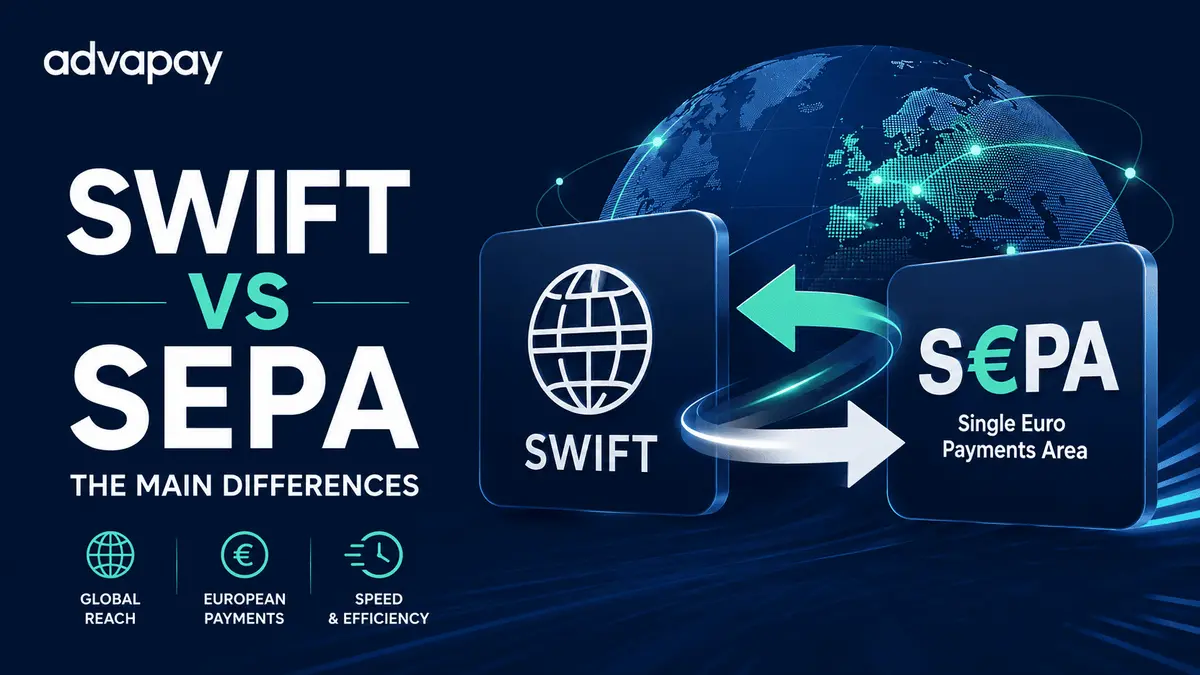
So the main difference is this: SWIFT is built for international reach and multi-currency payments, while SEPA is built for euro payments within the SEPA zone.
That sounds straightforward, but the operational consequences are significant. SWIFT payments often rely on correspondent banking chains, FX conversion, and more detailed payment instructions. SEPA payments are typically more standardised, especially for euro transfers between participating countries and institutions.
It is also worth being precise about terminology. SWIFT is not itself a payment rail in the same way many people casually describe it. It is primarily a messaging network that allows institutions to exchange secure payment instructions. SEPA, by contrast, is a scheme framework for euro payments. That distinction matters because message transmission, account servicing, settlement, and scheme participation are not the same thing.
SWIFT is built for global reach and multiple currencies. SEPA is built for euro payments within the SEPA area.
A SWIFT payment begins when a bank or payment provider sends a message through the SWIFT network to another financial institution. That message contains the payment instruction and the details needed to route the transfer.
Depending on the corridor, currency, and institutions involved, the funds may pass through one or more intermediary or correspondent banks before reaching the beneficiary bank. This is one reason SWIFT payments can vary in timing, cost, and transparency.
SWIFT is widely used because it supports international payments at global scale. According to SWIFT, its network connects financial institutions in more than 200 countries and territories. That global reach makes it the default option when a fintech needs to move money beyond Europe, outside the euro area, or in a non-euro currency.
In practical terms, SWIFT payments usually require the beneficiary's full bank details, an IBAN where relevant, a BIC or SWIFT code, accurate sender and recipient information, and in some cases additional intermediary bank data.
For fintechs, this means SWIFT payments usually need stronger payment-form design, better validation logic, clearer fee handling, and more robust exception management. That is one reason payments and transfers infrastructure matters so much in multi-rail products.
SEPA stands for the Single Euro Payments Area. It was created to harmonise cashless euro payments across participating European countries so that cross-border euro transfers can work more like domestic ones. This is how the European Commission describes the purpose of SEPA.
SEPA is not one single payment type. In practice, the SEPA framework includes SEPA Credit Transfer, SEPA Instant Credit Transfer, and SEPA Direct Debit.
For this comparison with SWIFT, the main focus is on bank transfers, especially SEPA Credit Transfer and SEPA Instant.
A SEPA transfer is designed for euro-denominated payments within the SEPA area. The European Central Bank explains that instant euro payments in Europe are based on the SEPA Instant Credit Transfer scheme.
For fintechs, SEPA is usually operationally simpler than SWIFT when the use case fits: the currency is euro, both institutions support the relevant SEPA scheme, the payment stays within the SEPA area, and the business does not need a global correspondent-banking route.
Because the format is more standardised, SEPA flows are often easier to automate, easier to explain to users, and easier to price predictably.
If your product is focused on European euro accounts, wallet top-ups, payouts, local account infrastructure, or day-to-day business payments, SEPA can be a core building block. That is especially relevant for fintechs building around core banking functionality and SEPA payment capabilities.
| Factor | SWIFT | SEPA |
|---|---|---|
| Geographic coverage | Global reach across countries and currencies | European payment area for euro transfers |
| Currency support | Multiple currencies | Euro-denominated payments |
| Payment model | Financial messaging, often involving correspondent banks | Standardised payment scheme framework |
| Speed | Depends on corridor, banks, cut-off times, and reviews | Usually more predictable for euro transfers, with SEPA Instant available in supported cases |
| Fees | Can include sender, receiver, intermediary, and FX costs | Usually simpler and more predictable for euro payments |
| Data requirements | Often requires more detailed routing and beneficiary information | Typically more standardised within the SEPA framework |
The first major difference is geographic coverage. SWIFT is global, while SEPA is regional. If the payment needs to reach a beneficiary outside the SEPA zone, SWIFT is usually the more relevant route.
The second is currency support. SWIFT supports multiple currencies, while SEPA is built for euro payments. This matters in real product design because a fintech supporting both euro and non-euro flows will often need different routing logic, fee models, and reconciliation processes depending on whether the transfer is sent over SEPA or through a SWIFT-connected international flow.
The third is speed and predictability. SEPA transfers, especially standardised euro flows, are often more predictable for intra-European use cases. SEPA Instant can also support near real-time payments where participants and scheme conditions allow, as noted by the ECB. SWIFT speed depends on the corridor, the banks involved, cut-off times, compliance reviews, and whether intermediary banks are part of the chain.
The fourth is fees and cost structure. SEPA payments are often cheaper and easier to price consistently for euro payments inside Europe. SWIFT payments can involve sender charges, receiver charges, shared charges, intermediary bank deductions, and foreign exchange spreads. That does not make SWIFT inefficient, but it does make the cost model more complex.
The fifth is beneficiary data and routing detail. SWIFT payments typically require more routing detail and stricter data quality. SEPA transfers are generally more standardised and often less operationally burdensome when the payment stays inside the SEPA framework. This affects onboarding, payment form UX, validation rules, support workload, and failure handling.
The final difference is operating model. SEPA is often the cleaner choice for European euro use cases, while SWIFT is usually the necessary choice for broader international reach. The real question is not which one is better in absolute terms, but which one matches the product, jurisdiction, currency model, and bank connectivity strategy of the business.
A business will usually prefer SEPA when it mainly serves customers in Europe, transfers are in euro, the payment flow is domestic-like or regional, pricing simplicity matters, and the product depends on repeatable, standardised payment operations.
A business will usually need SWIFT when it sends or receives international payments beyond the SEPA area, needs non-euro currency support, works with global suppliers, partners, or customers, supports treasury movement across jurisdictions, or requires access to broader international banking connectivity.
For many fintechs, the answer is not SWIFT or SEPA. It is SWIFT and SEPA, each used for the right payment scenario.
That is why payment architecture matters. Routing logic, account structure, FX handling, reconciliation, customer communication, and compliance review all become more complex once a product needs to support multiple rails. This is exactly where modular payment infrastructure for fintechs and a flexible digital core banking platform can make a practical difference.
For a consumer, the difference between SWIFT and SEPA may look like a simple question of destination and currency. For a fintech, it is an infrastructure decision.
It affects product design, customer experience, transaction fees, treasury operations, exception handling, payment-failure management, compliance workflows, and bank and provider connectivity.
A fintech launching in Europe may begin with SEPA because it offers a simpler foundation for euro transfers. As the business grows, SWIFT connectivity may become necessary for international corridors, non-euro accounts, or treasury operations.
That is why the more useful strategic question is not which is better, SWIFT or SEPA. It is which payment flows do we need to support, in which markets, under which licence and banking setup.
For operators building payment products, e-wallets, EMI or PI models, or digital banking services, the best outcome usually comes from designing the payment stack around actual use cases rather than around labels.
For a fintech, the SWIFT vs SEPA decision is not a glossary question. It is an infrastructure decision.