What it is
A branded financial product built on external technology and regulated financial infrastructure.
- Branded customer proposition
- External regulated service layers
White-label Banking-as-a-Service is an operating model in which a fintech offers financial products under its own brand while relying on external technology and regulated providers for some or all of the infrastructure underneath. The customer may experience one coherent product even though accounts, payments, cards, foreign exchange, compliance controls and safeguarding arrangements operate across several connected systems and contractual relationships.
That makes white-label BaaS considerably more than a ready-made banking application or a collection of APIs. The proposition still needs a reliable core banking and ledger layer, regulated access to the required financial services, customer and transaction controls, clearly allocated responsibilities and an operating team capable of managing both normal and exceptional activity.
The model can reduce how much a fintech needs to develop and connect before launch. It can also provide access to services that would be difficult or uneconomical to establish directly at an early stage. It does not, however, make the regulatory, operational or commercial work disappear. Much of that work moves into provider selection, integration, contract design and the ongoing management of relationships between the parties.
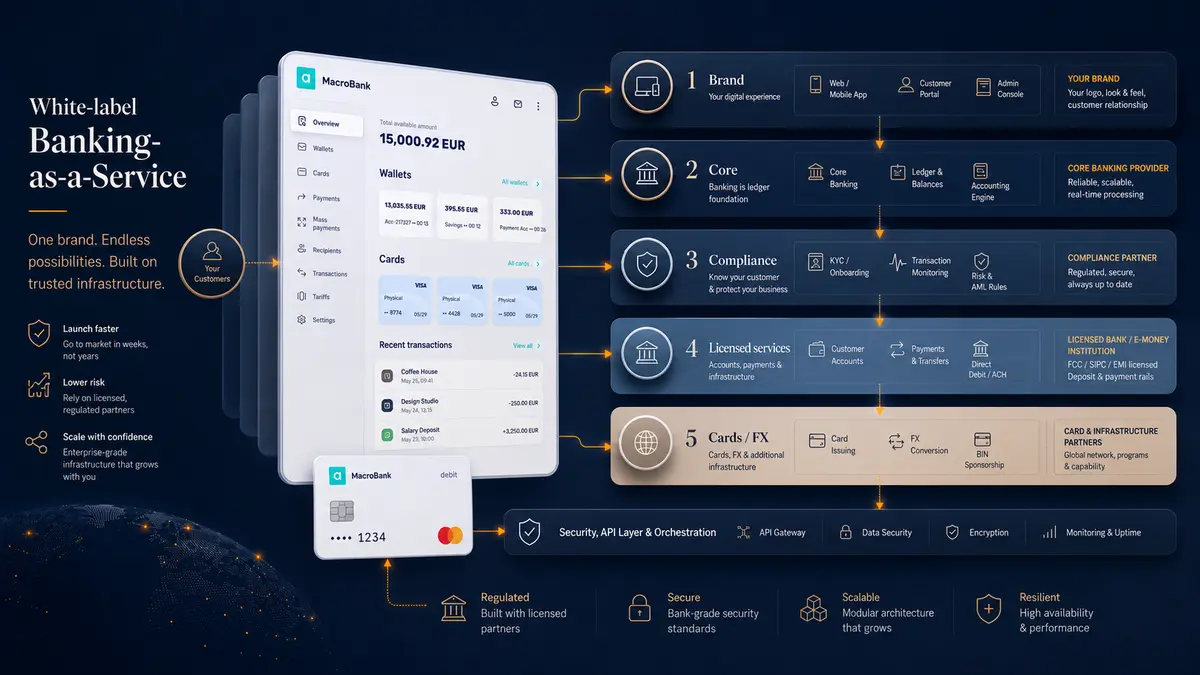
One customer proposition can depend on several connected technology, provider and regulatory layers.
A branded financial product built on external technology and regulated financial infrastructure.
Fintechs, neobanks, payment businesses, marketplaces and embedded-finance products use the model to launch faster.
It shortens access to core technology, providers and financial services that would be slow or expensive to build directly.
The complexity moves into responsibility design, provider fit, integration, reconciliation and contract management.
A stable core banking and ledger layer should sit underneath the proposition so providers can be added or replaced later.
Choose which capabilities the fintech must control directly and which should stay provider-supplied under the selected model.
As of July 2026, with a primary focus on European electronic money institutions, payment institutions, fintechs, neobanks and embedded-finance propositions. This guide provides general information and does not constitute legal or regulatory advice.
White-label banking describes how a financial product is presented to the customer. The application, product name, pricing, customer journey and communications appear under the fintech’s brand rather than the brand of the companies supplying the underlying infrastructure.
Banking-as-a-Service describes a different part of the model: the provision of regulated financial capabilities through a commercial and technical relationship with a licensed institution or another appropriately authorised provider.
Core banking software performs another function again. It manages customer and account records, balances, ledger entries, payments, fees, reconciliation and reporting. Customer-facing applications, core banking technology and regulated financial services are therefore related layers, but they are not interchangeable.
White-label Banking-as-a-Service combines a fintech’s branded customer proposition with core banking technology and regulated financial services supplied under the permissions of licensed providers.
The European Banking Authority has also examined white labelling as a distinct business model, describing arrangements in which a financial institution works with another financial or non-financial company to offer products or services under the partner’s brand.
The distinction matters because the terms “white-label banking platform” and “white-label banking software” are used to describe very different propositions. One vendor may provide only web and mobile applications. Another may supply the core banking engine but no regulated services. A BaaS provider may supply accounts and payment access but expect the fintech to source its own ledger, compliance tools and customer channels. A more integrated proposition may combine several elements, but the contractual and regulated roles still need to be separated.
BaaS is not itself a regulatory authorisation. As of July 2026, PSD2 and the E-Money Directive remain the applicable EU frameworks for payment services and electronic-money institutions. The EU co-legislators reached a provisional agreement on PSD3 and the new Payment Services Regulation in November 2025, but final adoption and application remain pending, as reflected in the European Parliament’s legislative status record.
A fintech may operate within a licensed provider’s agent, distributor or programme structure. It may instead hold its own EMI, PI or equivalent authorisation and use BaaS for banking access, payment connectivity, cards, FX or geographic coverage. It may also use a hybrid structure in which some services are accessed directly and others remain provider-supplied.
For a concise introduction to the underlying concept, read what Banking-as-a-Service means and how fintechs use it.
The most useful way to understand white-label BaaS is to separate the proposition into five connected layers. This prevents the common mistake of treating the customer application, core banking platform, compliance systems and regulated services as though they were one product supplied by one company.
Layer 1: brand and customer experience. This is what the customer sees and interacts with: the public website, onboarding journey, web banking application, optional mobile application, product descriptions, pricing, notifications, statements and support channels. The fintech usually controls the brand and commercial model, but the experience must reflect the customer-due-diligence policy, provider limits, restricted activities and approved geography. A polished interface cannot compensate for a mismatch between the promised product and the provider’s operating model.
Layer 2: core banking and ledger. The core records and operates the financial product. It manages customer and account records, balances, double-entry ledger postings, payment instructions and statuses, currencies, fees, restrictions, reconciliation, reporting and back-office access. When a customer sends a payment, the core validates the instruction, applies product rules, creates the ledger entries and routes the transaction to the selected provider. When the provider responds, the core updates the transaction, balance and reporting record. A provider API may execute a service, but it is not automatically a substitute for an independent operating ledger.
For a detailed explanation of this operating layer - including architecture, modules, deployment models, implementation and selection - read our core banking software guide.
Layer 3: compliance and operational controls. This layer covers KYC and KYB, risk scoring, sanctions and PEP screening, transaction monitoring, fraud controls, case management, manual approvals, account restrictions and audit trails. The process must be separated into its decisions. Collecting identity documents is not the same as verifying them. Verification is not the same as approving the customer. Generating an alert is not the same as investigating it or deciding whether a regulatory report is required.
Layer 4: regulated financial services and payment infrastructure. This layer enables customer money to be received, held, converted, transferred or spent. It may include payment accounts, named or virtual IBANs, SEPA transfers, instant payments, international payments, cards, foreign exchange, local payment methods and relevant safeguarding arrangements. The exact provider stack depends on the currencies, countries, customer segments, permissions and risk profile of the product.
Layer 5: regulatory and contractual structure. This layer defines which entity supplies each regulated service, which authorisation supports it, who contracts with the customer, who holds or safeguards funds, which party approves onboarding, how data and evidence move between the parties and how the relationships can be changed or terminated. It can include the fintech’s own authorisation, an agent or distributor arrangement, outsourcing contracts, programme agreements, banking relationships, card agreements, data-processing terms and exit provisions.
The fifth layer is not paperwork added after the product has been designed. It shapes what the product can offer, which customers it may serve and how the technology must operate.
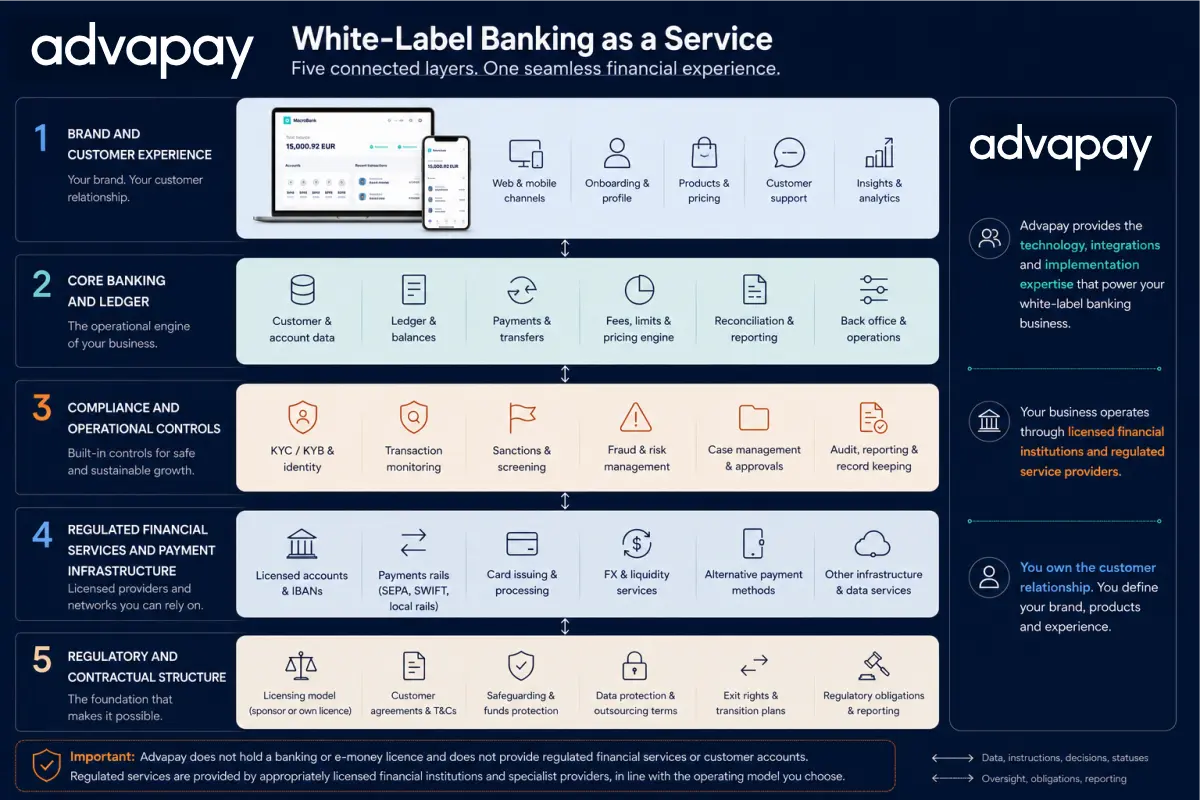
A white-label banking product may appear as one service to the customer, but it operates across connected customer, core banking, compliance, provider and regulatory layers.
There is no single legal or operational structure called “white-label BaaS.” The term covers several models that may look similar to the customer but create materially different responsibilities behind the product.
Sponsored, agent or distributor model. In a sponsored structure, the fintech performs defined activities within the regulatory and operational framework of a licensed provider. Depending on the jurisdiction and services, it might act as an agent, distributor, programme manager or another type of commercial and operational partner. This does not mean that the fintech borrows or rents the provider’s licence. The activities, customer relationship and division of responsibilities must fit the applicable structure and be documented accordingly. The licensed institution may issue the e-money or provide the payment service, establish the customer-acceptance policy and retain final onboarding authority, while the fintech controls the brand, collects data and provides first-line support.
Own licence plus BaaS. A licensed EMI or PI may use BaaS providers for infrastructure it does not wish to access directly, including safeguarding or operational banking, IBAN issuance, scheme connectivity, international payments, cards, FX or local-market services. Its own authorisation may provide more control over the proposition, but it also places more governance, compliance, safeguarding, reporting and operational responsibility with the fintech. The provider supplies a defined service; it does not replace the licence.
Technology-led programme model. Here, the product, brand and customer experience sit with the fintech while regulated services are supplied through one or more licensed institutions. The core banking platform connects the customer channels to the provider infrastructure and maintains the operational record across the programme. The customer may interact almost entirely with the fintech even though the terms and disclosures identify another institution as the issuer or payment-service provider. Commercial ownership of the experience does not automatically determine the legal customer relationship or regulatory responsibility.
Hybrid and multi-provider model. Many live propositions combine a direct account relationship for one currency, a BaaS provider for another market, a specialist card issuer, separate FX providers and a compliance stack operated partly in-house and partly through vendors. This can increase resilience and coverage, but it also increases the number of reconciliations, operational procedures and contractual boundaries that the fintech must manage.
Consider two fintechs offering branded EUR accounts and payments. The first operates within an EMI sponsor’s programme. The sponsor issues the e-money, maintains the safeguarding arrangement and approves customers under its policy. The fintech provides the interface, collects onboarding data and handles first-line support. The second fintech has its own EMI licence and safeguarding responsibilities but uses an external provider for named IBANs and SEPA connectivity. Customers may see similar applications, yet the legal relationships, funds flow, control environment and incident procedures underneath are substantially different.
PSD2 treats agents and outsourced operational functions separately, while authorised institutions remain responsible for the obligations attached to their permissions. The EBA outsourcing framework likewise applies to payment and electronic-money institutions and requires them to retain sufficient substance, governance and oversight.
When founders first look at BaaS, the discussion often starts with APIs and features.
In practice, the more important questions are who approves the customer, who holds or safeguards the funds, who monitors the activity and who is responsible when something falls outside the normal flow.
| Activity | Fintech | Licensed or BaaS provider | Technology provider | Specialist provider |
|---|---|---|---|---|
| Product and pricing | Usually leads | Reviews where relevant | Supports configuration | May affect service scope |
| Customer interface | Usually leads | May impose requirements | Supplies or supports channels | May provide embedded components |
| Data collection | Often performs | Defines required information | Enables workflows | May verify data |
| KYC decision | Depends on model | Often retains approval authority | Records workflow and decision | Supplies verification or screening |
| Account or e-money issuance | Customer-facing role varies | Relevant licensed issuer leads | Records account and ledger data | Normally not responsible |
| Payment execution | Manages customer journey | Executes regulated service | Routes and records instructions | May supply a payment method |
| Transaction monitoring | May perform first-line work | Retains applicable responsibility | Supports monitoring workflow | May generate alerts |
| Safeguarding | Supports records and reconciliation | Relevant licensed entity leads | Provides ledger and reconciliation data | Banking partner may hold accounts |
| Customer support | Usually leads first line | Handles regulated escalations | Supplies case-management tooling | Supports service-specific cases |
| Incident management | Coordinates customer response | Leads regulated escalation where relevant | Handles technology incidents | Handles provider-specific incidents |
| Regulatory reporting | Supplies relevant data | Responsible under its permissions | Produces reports and evidence | Supplies service data |
Illustrative only. The actual allocation depends on the jurisdiction, regulated permissions, product, contracts and operating model.
A white-label banking proposition can range from a focused payments product to a multi-currency financial platform combining accounts, cards, FX, local payment methods and specialist compliance services.
Customer and account services. The account layer may support retail and business onboarding, customer profiles, payment accounts or wallets, multi-currency balances, named and virtual IBANs, statements, beneficiaries, pricing plans and account limits. The terminology must match the underlying arrangement. A virtual IBAN may be used for payment identification and reconciliation without necessarily constituting a separate payment account in the customer’s name.
Payments and money movement. The payments layer may support SEPA Credit Transfer, SEPA Instant, international payments, local payment methods, bulk and scheduled payments, direct debits where relevant, collections, payouts and foreign exchange. SEPA Instant enables euro credit transfers with funds made available within ten seconds under the applicable scheme and legal framework. International payments may use correspondent relationships and secure messaging through Swift, which provides financial messaging infrastructure rather than the underlying customer account or settlement service. Access through a provider does not automatically make the fintech a direct participant in the relevant scheme or infrastructure. For a deeper comparison, see SEPA and Swift payment infrastructure.
Cards and acceptance. A card proposition may include physical and virtual cards, cardholder controls, tokenisation, authorisation and processing connectivity, card fees and dispute workflows. It typically introduces its own chain of issuer, programme, processor, manufacturer and personalisation relationships. Merchant acquiring or payment acceptance can also be connected where it forms part of the model, but it is an optional adjacent capability rather than a universal component of white-label banking.
Compliance and operations. The operating environment may support KYC and KYB, screening, transaction monitoring, fraud controls, fee calculation, ledger accounting, reconciliation, reporting, payment investigations and customer-support cases. The presence of a technical feature does not determine who is responsible for using it. A monitoring module may generate alerts, but the operating model still needs to identify who reviews them, what escalation rules apply and which party makes the final decision.
The available combination always depends on the selected providers, their permissions and risk appetite, the customer segment, currencies, geography and implementation scope.
Typical use cases include a launch-stage fintech building its first account or payments product, an authorised EMI or PI adding new currencies or rails, a marketplace introducing collections and payouts, and an established institution launching a new digital brand. The model is less suitable where the required customer profile falls outside provider risk appetite or where the institution’s scale and operating capability make direct access more economical.
A white-label BaaS project should begin with the business model rather than a platform demonstration or provider price list.
Define the proposition. The team should establish who the customer is, where customers are resident or incorporated, which services and currencies are required, how the company will earn revenue and how customer funds will enter, move through and leave the model. The output should be a product map and an end-to-end funds flow rather than only a feature list. The funds flow identifies the parties touching the money, the accounts used, the required ledger postings and the points at which reconciliation must occur.
Determine the operating and regulatory model. The business must decide whether it will operate within a provider’s sponsored structure, use its own licence, combine an authorisation with BaaS infrastructure or phase from one model into another. The customer contract, regulated disclosures, safeguarding model and provider agreements should all describe the same flow.
Validate providers before finalising the product. A provider may support the required currency and payment method but reject the target jurisdiction, customer industry, transaction type, distribution model, expected volume or source of funds. Its feedback may change the onboarding journey, permitted activities, transaction limits and commercial model. A technically complete platform cannot launch a service that no regulated provider has approved.
Configure and integrate the platform. Once the model is sufficiently validated, the core banking environment can be configured around customer types, account structures, currencies, products, fees, limits, approvals, user permissions, reporting and reconciliation. External providers are then connected to the core and customer channels. The implementation should avoid mirroring one provider’s data model throughout the complete product. Internal account, transaction and status definitions should be stable enough to support another integration later.
Prepare operations and test exceptions. A successful test payment proves only that the normal route works. Production readiness requires testing incomplete onboarding, manual-review cases, screening and monitoring alerts, duplicate provider messages, delayed confirmations, payment failures, reversals, refunds, reconciliation differences, provider downtime, account restrictions, complaints and funds-return scenarios. For each case, the teams need to know which party detects the issue, who investigates it, who communicates with the customer and how the outcome is recorded.
A practical example. Consider a fintech launching EUR business accounts for small companies. Its original plan includes digital onboarding, named IBANs, SEPA payments and multi-user access. During provider discussions, it learns that several intended industries require manual approval and additional ownership evidence, while certain payment types must be reviewed before execution. Those requirements affect more than the compliance policy. The onboarding interface needs new fields, the core needs review statuses and restrictions, the support team needs evidence-request procedures, and payment workflows need approval queues. Customer terms and launch communications may also change. Beginning provider discussions early allows these requirements to become part of the design rather than late rework.
Based on Advapay’s project experience, a focused technology and provider-integration project with a defined scope and an approved partner relationship may take approximately three to six months. Multi-provider projects, extensive customisation, data migration or a separate mobile application may require six to twelve months or longer. A new regulatory authorisation can extend the overall launch timeline beyond the technology implementation itself. These are indicative planning ranges, not delivery commitments.
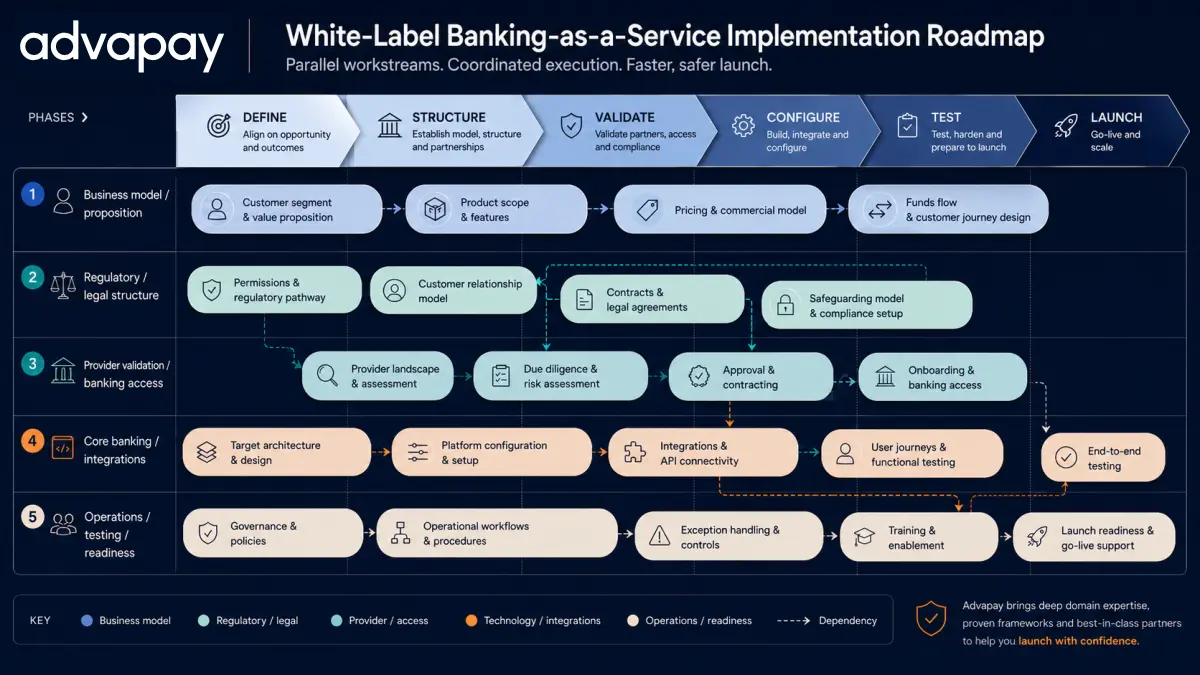
Product definition, regulatory design, provider validation, platform implementation and operational readiness proceed in parallel rather than as isolated sequential projects.
I have seen projects lose months because banking and BaaS discussions started only after the platform had already been configured.
The provider’s risk appetite can change the customer journey, the funds flow and even the product itself, so that conversation has to begin much earlier.
If you are planning a white-label fintech launch, you need to align the operating model, core banking platform, provider integrations and licensing project before implementation begins. Contact our team to discuss details.
“The provider handles compliance” is rarely precise enough to operate a live financial product. A workable responsibility model distinguishes who performs the process, who supplies the technology, who makes or approves the decision, who retains the applicable regulatory responsibility, who supplies data to the other parties and who maintains the evidence.
Onboarding illustrates the distinction. The fintech may design the interface and collect customer information. An identity provider may verify a document and perform a biometric comparison. A screening provider may check sanctions and PEP lists. The core banking platform may record the results and route the case. None of those activities necessarily determines who can accept the customer. Depending on the structure, the licensed institution may retain approval authority under its policy. Alternatively, an independently licensed fintech may make the decision within its own framework while using vendors for verification and infrastructure. A “verification passed” status should not automatically be treated as “customer approved” unless that is genuinely how the agreed control works.
Payment execution creates another chain. A customer may create a payment through the fintech’s application. The core checks the available balance, permissions, limits and transaction controls. A monitoring tool may produce an alert. The payment provider validates and executes the regulated service. If the payment is rejected, delayed or recalled, the provider supplies the status, the core records the change, operations investigate, the fintech communicates with the customer and the licensed institution may determine whether a regulatory escalation is necessary. The control framework should specify how information moves through that chain and which record is authoritative.
Safeguarding and reconciliation cannot be separated. Where the model involves relevant payment services or electronic-money issuance, the authorised institution remains responsible for the applicable safeguarding requirements under PSD2 or the E-Money Directive. The technology does not assume the regulated obligation, but it must support it. Customer liabilities, provider balances, safeguarding-account information and unsettled transactions must be reconcilable. A difference can indicate a missing or duplicated transaction, delayed settlement, incorrect status mapping, an allocation error or a mismatch between recorded liabilities and the relevant protected funds. The process needs defined tolerances, escalation times and ownership.
Outsourcing requires oversight. The EBA Guidelines on outsourcing cover payment and electronic-money institutions and address governance, due diligence, auditability, continuity and exit arrangements. Where DORA applies, financial entities must also manage ICT third-party dependencies and contractual arrangements for services supporting critical or important functions. Data-protection roles must be determined separately from marketing descriptions. Under the GDPR, controllers using processors must select providers offering sufficient technical and organisational guarantees and govern the processing through the required contractual arrangements.
Evidence matters as much as performance. A responsibility matrix should identify where each input originates, who reviews it, who can approve or override, which status is recorded, what evidence is retained and how it can be produced for an audit, banking partner or regulator. When these details are left until after implementation, teams often rely on email, spreadsheets and informal escalation channels to fill the gaps between systems.
“The API tells the systems how to communicate. The operating model tells the teams who approves the customer, who controls the money and who must produce the evidence.” — Nikola Kosović
There is no meaningful single price for white-label Banking-as-a-Service because the proposition combines technology, implementation, regulated providers and internal operations.
Based on Advapay’s project experience, a SaaS core banking platform may start from a few thousand euros per month and move into the low five figures as scope and scale increase. Implementation and standard integrations commonly begin in the tens of thousands of euros, while extensively customised, multi-provider, on-premise or source-code projects may move into six figures. These are directional software and implementation ranges, not an all-in project quotation. Regulated-provider, transaction, card, compliance and internal operating costs are normally additional.
The delivery model changes the cost structure. Under SaaS, more hosting, maintenance and platform operations are bundled into recurring fees. An on-premise perpetual licence creates a higher upfront software and deployment cost and moves more infrastructure responsibility to the client. A source-code model provides greater access to and control over the software code under the agreed licence terms, and normally requires a bespoke commercial scope.
The lowest platform price is not necessarily the lowest total cost of ownership. A fragmented stack can appear inexpensive at vendor level but create additional integration, reconciliation, support and incident-management costs. Conversely, an extensive platform package may include capabilities the business does not need during its initial stage.
The useful comparison is the expected cost of operating the complete proposition over several years: technology, provider minimums, usage fees, internal staff, compliance, customer support, maintenance, resilience and future change.
| Cost category | Examples | Typical pattern | Key planning question |
|---|---|---|---|
| Platform | SaaS, on-premise perpetual licence or source-code model | Recurring or upfront | How much control and technical responsibility are required? |
| Implementation | Configuration, integrations, testing and migration | Primarily one-time | How much of the scope is standard and how much is custom? |
| Customer applications | Web and optional mobile application | Included or separate scope | Which channels are necessary for the initial launch? |
| Provider onboarding | Accounts, payments, cards, FX and compliance | Setup fees and minimums | Which costs sit outside the software contract? |
| Usage | Payments, accounts, cards, FX, KYC and monitoring | Volume-based | How will the unit economics change as volumes grow? |
| Internal operations | Compliance, support, treasury and reconciliation | Ongoing operating expense | Which responsibilities remain in-house? |
| Support and resilience | Hosting, maintenance, monitoring and continuity | Recurring | Which service levels and recovery capabilities are required? |
| Migration and exit | Data export, transition and provider replacement | Event-driven | What would it cost to change the operating model later? |
Commercial structures vary by provider, jurisdiction, implementation scope, volumes and delivery model.
Provider selection should begin with the product, customer and funds flow rather than an API feature list. A technically strong provider can still be unsuitable if it lacks the required geographic coverage, rejects the customer segment, imposes transaction restrictions that undermine the commercial model or provides insufficient data for reconciliation.
Establish the model first. Define the regulated role of each party, the customer relationship, countries and segments in scope, currencies, transaction types, expected volumes, account and safeguarding structure, payment routes and the controls the fintech can operate internally. This gives providers a real proposition to assess rather than a generic request for accounts, IBANs or APIs.
Test practical risk appetite. A provider’s permissions do not reveal its complete appetite. Confirm whether it supports the intended industries, countries, source and destination of funds, onboarding method, platform or intermediated customers, transaction sizes and any higher-risk feature of the product. A provider should not be selected simply because it says that it supports fintechs or offers the required currency.
Evaluate the operating service. Understand onboarding decision times, manual-review procedures, payment cut-offs, error handling, support channels, incident escalation, reconciliation files, reporting and planned maintenance. A good sales demonstration does not compensate for unclear exception handling.
Understand the commercial structure. Compare setup fees, monthly minimums, account and transaction fees, FX spreads, card fees, compliance charges, support fees and volume commitments against realistic volumes. Identify which fees can change, what notice applies and whether minimum commitments begin during implementation.
Confirm continuity and exit rights. The contract should provide usable access to transaction and reconciliation data, proportionate suspension and escalation processes, clarity on subcontracting, and a practical route to export data and transition the service. Relevant EBA and DORA requirements also emphasise third-party oversight, continuity and exit planning.
This section provides the decision framework. For the detailed questions, evidence requests and contract review points, use the guide on how to evaluate a BaaS provider.
| Model | Launch speed | Regulatory control | Initial investment | Operational burden | Provider dependency | Typical fit |
|---|---|---|---|---|---|---|
| Sponsored white-label BaaS | Higher | Moderate | Lower | Shared but still material | Higher | Launch-stage or non-licensed proposition |
| Own licence plus BaaS | Moderate | Higher | Medium to high | High | Moderate | Regulated fintech seeking external infrastructure |
| Direct provider and rail relationships | Lower | High | High | High | Lower for the relevant service | Scaling institution with sufficient capability |
| Predominantly proprietary infrastructure | Lowest | Highest | Very high | Very high | Lower at platform level | Large, technically mature institution |
The relative assessment depends on the jurisdiction, permissions, product scope and capabilities retained in-house.
White-label infrastructure reduces the amount of proprietary development and provider integration required before launch, but it does not eliminate implementation or operating responsibility. Building in-house provides more control over product logic, the data model and the technology roadmap, but it also requires the institution to develop and maintain the ledger, back office, customer channels, integrations, security, resilience, reporting and ongoing regulatory change.
The build-versus-buy decision is therefore not simply a comparison of software prices. It is a decision about which technology and operating capabilities the business has the time, capital and internal expertise to own. For many launch-stage fintechs, white-label banking provides faster access to a proven operating stack. Larger or more technically mature institutions may prefer a hybrid model in which they retain control over selected layers while consuming other capabilities from specialist providers.
A provider that enables the launch should not make the product impossible to operate without that one relationship. Complete independence is neither realistic nor always desirable: financial products naturally depend on banks, schemes, payment systems, data vendors and technology. The objective is to understand those dependencies and avoid making change unnecessarily expensive or disruptive.
Keep the core record stable. Customer, account, balance and transaction records should not exist only inside the provider’s platform or portal. The core banking and ledger layer should maintain the internal representation of the product, while provider-specific identifiers and statuses are mapped into it. This helps preserve a consistent customer experience and reporting model when providers use different terminology or workflows.
Preserve independent reconciliation. The fintech should be able to compare internal customer liabilities, provider account balances, settlement positions, pending transactions, fees and exceptions without relying solely on a provider dashboard. Where several providers are used, the core needs to reconcile each external position separately while presenting a consolidated operating picture. Macrobank can support reconciliation across several providers.
Separate business logic from provider logic. Not every provider-specific rule can be abstracted, but the product should avoid hard-coding its complete operating model around one API. Internal statuses, limits, fee rules and customer permissions should be designed at product level where practical, with provider adapters translating between that model and the external service.
Plan the exit before it is needed. Contracts and implementation documentation should address exportable data, formats, historical records, transition assistance, notice periods, continued access, migration testing, customer communications and deletion or retention after termination. The EBA outsourcing framework and DORA both reinforce the importance of exit strategies and the ability to transition relevant services without undue disruption or regulatory non-compliance. A migration may require onboarding the replacement provider, integrating and testing it, migrating or reissuing accounts and identifiers, reconciling both environments, updating terms and maintaining controlled parallel operations.
Use diversification deliberately. A second provider can improve geographic coverage, negotiation leverage or resilience, but it also introduces additional minimum fees, integrations, operating procedures, compliance requirements and reconciliation. Multi-provider architecture is useful when it solves a defined problem, not simply because it sounds more resilient.
The right provider can accelerate a launch, but the product should not become impossible to operate without that one relationship.
I would always want the core data, reconciliation and business logic to remain portable enough for the company to add or replace providers later.
Advapay supports white-label BaaS projects through Macrobank core banking software, implementation services, a marketplace of partners and integrations, and licensing-project consulting.
Macrobank can provide the operating layer for customer and account records, balances and ledger entries, payments and fees, reconciliation, reporting, customer web applications and back-office operations. A mobile application is available as a separate optional module.
The platform supports more than 60 ready integrations across banking, payments, cards, foreign exchange, identity, compliance and related infrastructure. Additional integrations can be developed where the required provider is not already available. Explore Advapay’s banking and payment integrations.
Macrobank is available through SaaS, an on-premise perpetual licence or a source-code model. Advapay can coordinate multi-provider implementations, support reconciliation between several external services and assist with provider replacement or migration.
Advapay works with more than 100 clients through a team of around 60 people across seven offices in Tallinn, London, Amsterdam, Belgrade, Warsaw, Madrid and Toronto. Its licensing-project consulting can connect the technology implementation with business-model preparation, regulatory-project planning, operating-model design, provider requirements and launch sequencing.
Advapay is a B2B technology and consulting company. It does not itself provide bank accounts, payment services or other regulated financial products to end customers. Those services are supplied by the relevant licensed institutions and partners. Advapay’s role is to provide the technology, implementation and consulting required to connect those services to the fintech’s operating model.
For the commercial proposition and available partner categories, explore Advapay Banking-as-a-Service.
Direct answers to the most common questions about white-label Banking-as-a-Service.
White-label BaaS is a model in which a fintech offers a financial product under its own brand while using external core banking technology and licensed providers for capabilities such as accounts, payments, cards and FX. The exact division of services and responsibilities depends on the operating structure.
White-label banking describes the branded customer proposition, including its applications and product experience. BaaS describes how regulated financial capabilities are supplied by licensed providers. A white-label product may use BaaS, but it also needs technology, controls and a defined regulatory structure.
No. Core banking software manages customer records, accounts, balances, ledger entries, payments, fees and reporting. White-label banking is the broader proposition and may include the core platform, customer applications, regulated services and provider integrations.
In some structures, a fintech may perform defined activities as an agent, distributor or programme participant within a licensed provider’s framework. Other fintechs hold their own authorisation and use BaaS for infrastructure. The appropriate structure depends on the services, jurisdiction and customer relationship.
It depends on the product and structure. Funds may be held by a bank, safeguarded by an EMI or payment institution, or managed through another permitted arrangement. The contracts, account structure, customer terms and reconciliation process should identify the relevant entity clearly.
Responsibilities may be divided. The fintech may collect information, a specialist provider may perform verification or screening, and the licensed institution may retain approval authority for defined controls. The allocation should identify who performs, decides, escalates and retains evidence.
It may include onboarding, accounts, wallets, multi-currency balances, IBANs, payments, cards, FX, customer applications, back-office tools, KYC and KYB, monitoring, reconciliation and reporting. Availability depends on provider permissions, geography, currencies, customer profile and scope.
Based on Advapay’s project experience, a focused technology and provider-integration project with a defined scope and approved partner relationship may take approximately three to six months. Multi-provider projects, extensive customisation, migration or a separate mobile application may require six to twelve months or longer. A new regulatory authorisation can extend the overall timeline.
Based on Advapay’s project experience, SaaS software may begin at a few thousand euros per month, while implementation commonly begins in the tens of thousands. Complex, multi-provider, mobile, on-premise or source-code projects may move into six figures. Banking, card, transaction, compliance and internal operating costs are usually separate.
Yes, where the technology, operations and contracts support it. Several providers may improve coverage or resilience, but they also add integration, reconciliation and vendor-management complexity. The business case should justify the additional operating burden.
Migration is possible, but its difficulty depends on the architecture and contract. Data portability, independent ledger records, termination assistance, historical information and transition support should be addressed before launch rather than when the relationship is already ending.
Direct access may become appropriate when the institution has the necessary permissions, operating capacity, transaction scale and commercial case. It can provide more control but also introduces greater technical, treasury, compliance, governance and continuity responsibilities.
If you are weighing sponsors, core banking, provider fit, and future portability, Advapay can help turn the model into a launch plan your team can actually operate.
Input your email and our team will get back to you within one business day.
Or, if you would rather discuss your model, target market, and launch route directly:
Send us more details →