



Advapay core banking guide
Core banking software is the central operating system that maintains customer and account records, applies product rules, posts transactions to the ledger and gives customer channels, operators and external providers a consistent source of truth. It is the part of a financial product that must still be correct when an API is delayed, a payment is returned or an operator has to explain why a balance changed.
This guide is written for two teams facing the same underlying decision from different directions: founders launching a regulated fintech and technology leaders replacing a legacy core. It explains what the platform should own, how modern core banking architecture is structured, which modules and integrations matter, how implementation and migration work, and what evidence to request before selecting a vendor.
A core banking platform does not grant a licence, provide scheme membership or automatically create banking access. It is also not the same as the customer-facing app, a Banking-as-a-Service relationship or the external processor that executes a payment or card transaction. Its job is to operate the product and preserve a reliable financial record across those connected layers.

Core banking at a glance
- Record: The core is the controlled record of customers, accounts, balances, transactions and product rules.
- Ledger: A credible platform must preserve double-entry integrity and reconcile internal positions with banks, payment providers, card processors and other external systems.
- Controls: Permissions, approvals, audit history, reconciliation and exception handling turn financial functionality into an operable system.
- Providers: The core orchestrates services, but specialist providers may still perform identity verification, screening, payment execution, card processing, FX or crypto custody.
- Ownership: SaaS, customer-controlled deployment and source-code purchase allocate infrastructure, release, security and maintenance responsibilities differently.
- Delivery: A settled standard implementation may be planned over two to three months; complex card, crypto, mobile or migration programmes commonly require six months or more.
Scope note: This guide focuses on payment institutions, electronic money institutions, fintechs, neobanks, remittance businesses and crypto-fiat propositions. The required architecture and controls vary by business model, jurisdiction and provider structure. Software capability is not regulatory authorisation.
What core banking software actually does
Core banking software is the system of record that connects product configuration with day-to-day financial operations. It maintains the customer and account structure, calculates available balances, applies tariffs and limits, records transaction states and creates the postings that explain every movement of value.
The phrase system of record is important. A core is not simply a screen that displays data received from a banking provider. It must preserve the institution’s own consistent view of what has happened, including activity that has been initiated but not completed, rejected instructions, returns, reversals, fees and manual corrections. When several customer channels or providers are connected, each should read from or write back to that controlled record through defined interfaces.
The financial ledger records the economic effect of customer and operational activity. A general ledger then organises those postings into the institution’s accounting structure. The two concepts may be implemented within one platform, but they serve different purposes: the first explains customer balances and transaction positions; the second supports financial control, period closing, reporting and accounting. They must remain reconcilable.
Consider a multi-currency payment account. The product engine defines which currencies are available, how accounts are numbered, which fees apply, the customer’s limits and which operations are permitted. When the customer converts currency or sends a payment, the platform validates the instruction, calculates the fee, changes the appropriate balance and records the transaction history. The external FX or payment provider may execute part of the service, but the core should retain the internal record before, during and after that interaction.
What sits inside the core varies. Accounts, payments, fees, limits, ledgering, reconciliation, reporting and operational access commonly belong there. Identity verification, sanctions screening, payment rails, card processing, safeguarding accounts and liquidity often remain with connected providers. The correct boundary is not “everything in one system”; it is a clear allocation of records, decisions and responsibilities.
For a shorter introduction, see what core banking software actually does in 2026.
Core banking vs digital banking, BaaS and payment processing
Core banking keeps the institution’s internal customer, account, balance and transaction record. Digital banking software presents services to users. Banking-as-a-Service supplies regulated capabilities through a provider relationship. Payment processors and rails execute defined external functions. One proposition may combine all four, but they are not interchangeable.
| Layer | Primary job | Record or responsibility it normally owns | What it still depends on |
|---|---|---|---|
| Core banking software | Operates the financial product and keeps its internal record | Customers, accounts, balances, ledger entries, transaction states, fees, limits and reconciliation data | Regulated permissions, banking access and external service providers |
| Digital banking software | Presents the product to customers and staff | Journeys, screens, instructions, notifications and channel preferences | The core and provider APIs that supply the underlying service |
| Banking-as-a-Service | Supplies regulated or financial capabilities under a commercial and technical relationship | Depends on the contract: it may include accounts, payments, cards, FX, safeguarding or programme controls | The licensed provider’s permissions, policies, infrastructure and accepted risk scope |
| Payment processor or rail | Authorises, clears, settles or transports a particular transaction type | Processor and scheme messages, execution statuses and settlement records | Scheme membership, sponsor or banking relationships and reconciliation with the core |
Digital banking is the experience layer. A customer may use a web or mobile application to open an account, see a balance, create a beneficiary and approve a transfer. The app should not independently invent the balance or final payment state; it presents information and sends instructions to the controlled operating layer.
For the customer-experience category, read digital banking explained. For the narrower relationship between a modern backend core and a fintech proposition, read digital core banking for fintechs.
White-label Banking-as-a-Service is an operating model rather than a software module. A licensed provider may supply account infrastructure, payment access, cards, FX or another regulated service, while the fintech owns the brand and parts of the customer journey. In another model, the fintech holds its own licence but uses BaaS for selected infrastructure. The contracts, permissions and division of duties determine the real model.
A payment processor performs a narrower function. For example, a card processor may authorise transactions and communicate with a card scheme, while a bank or payment provider executes account-to-account transfers. The core creates and tracks the corresponding internal transaction, applies product rules and reconciles the external result.
This separation matters when a provider portal appears to show everything the business needs. A portal may show the provider’s view of accounts and payments, but it does not automatically replace the institution’s independent ledger, cross-provider record, fee logic, operational controls or reconciliation. If the provider is unavailable or replaced, the fintech still needs to know what each customer owns and how that position is supported externally.
How modern core banking architecture works
A modern core should separate the stable customer, product and ledger record from customer channels and provider-specific integrations. Controlled APIs, workflows, reporting, operational tools and observability then surround that record, allowing the institution to change channels or providers without redesigning its entire financial model.
The architecture can be understood as six connected layers:
- Customer and operator channels. Web banking, mobile apps, operator back office, partner portals and agent APIs collect instructions and present results. They should enforce channel-level permissions without becoming separate financial records.
- API and workflow layer. Authentication, authorisation, orchestration, approvals and business processes control how instructions reach the core. Public, customer and operator APIs may expose different capabilities and data.
- Customer and product services. This layer maintains customer profiles, account products, currencies, tariffs, limits, permissions and configurable business rules.
- Accounts and ledger. The platform creates accounts, calculates balances, records transactions and produces traceable double-entry postings. This is the stable centre of the architecture.
- Controls, reporting and reconciliation. Audit history, operational queues, financial accounting, exception management, reporting and reconciliation allow the institution to prove and operate what the core has recorded.
- Provider adapters. Connectors translate the institution’s stable internal definitions into each bank, payment rail, card processor, KYC provider, FX service or crypto platform.
Modularity matters because customer management, payments, accounting, cards and integrations evolve at different speeds. A modern design may combine clear domain modules with several purpose-built runtime services, rather than forcing every business capability into either one monolith or its own microservice. This allows useful separation and selective scaling without multiplying network calls, operational overhead and consistency problems. The questions that matter are whether boundaries are clear, financial consistency is preserved and failures are observable – not how many services appear on an architecture diagram.
APIs also require more than documentation. A production interface needs authentication, versioning, idempotency and a predictable error model. Idempotency prevents the same instruction from being processed twice when a caller retries after a timeout. Status mapping ensures that the institution understands what “accepted”, “pending”, “settled”, “rejected” or “returned” means across providers. Webhooks or events should be traceable, and operators need a way to investigate missing or contradictory messages.
The financial ledger and the general ledger should be distinguishable but connected. Customer and transaction balances explain the financial position at product level. The general ledger groups that activity into the chart of accounts used for accounting, reporting and control. Reconciliation then compares internal positions with correspondent, safeguarding, settlement or processor records. A platform that can post transactions but cannot show and resolve differences is incomplete operationally.
For replacement projects, architecture also determines migration strategy. A phased or “strangler” approach moves selected products, customers or processes to the new platform while the legacy system remains temporarily active. A big-bang cutover moves the defined population at once. Neither is automatically superior: the right decision depends on data quality, product dependencies, operational tolerance, reconciliation capability and the ability to run both records in parallel.
Read modern core banking architecture in more detail, but treat absolutes such as “cloud-native is always better” with caution. Deployment is a responsibility model, not a quality certificate.
Essential modules and capabilities
The minimum viable core is determined by the business model. A regulated payments or e-money operation normally needs customer and account management, a reliable ledger, payments, fees and limits, financial accounting and reconciliation, reporting, access controls and integration capability. Other modules may be native, optional or supplied through specialist providers.
Start with the operating jobs the institution must perform.
Onboard and maintain customers. The core should store customer and business profiles, related parties, documents, risk attributes, product relationships and account status. KYC and KYB providers may verify identity or company information, but the institution still needs to record the decision, evidence, restrictions and later changes.
Configure products and accounts. Operators need to create account structures, currencies, IBANs or provider account references, tariffs, fee rules, limits and customer groups. Product configuration should be controlled and auditable; a commercial change must not silently alter historical records.
Move and price money. The platform should support the transaction types required by the model, such as internal transfers, SEPA, SWIFT, local payments, FX or mass payments. It should calculate fees, apply limits, track approvals and preserve transaction states. The external provider executes the relevant rail; the core records the instruction and outcome.
Account, reconcile and report. The platform needs ledger postings, a usable chart of accounts, statements, period procedures, operational reports and reconciliation. For more depth, see general ledger and accounting in core banking.
Control operations. Role-based permissions, authentication options, audit trails, four-eyes approvals where needed, restricted-account handling and operator queues turn functionality into an operable system.
Manage cards. A full card-management module should cover physical and virtual card ordering, activation, block and unblock, closure, replacement and renewal, card funding movements, transaction and authorisation history, statements and reconciliation. The core is the management and orchestration layer. The connected issuer and processor perform real-time card processing and scheme connectivity.
Integrate specialist services. KYC/KYB, screening, transaction monitoring, payment execution, card processing, FX, crypto custody and KYT may be external even when the core starts the workflow and stores the result. The core banking capability checklist should therefore be read with an “included, integrated or optional” distinction.
| Capability | EMI or PI | MSB or remittance | Neobank proposition | Crypto-fiat proposition |
|---|---|---|---|---|
| Customer and account record | Core | Core | Core | Core |
| Double-entry ledger and GL | Core | Core | Core | Core |
| Payment orchestration | Core for offered rails | Core for offered corridors | Core | Core for fiat legs |
| Fees, tariffs and limits | Core | Core | Core | Core |
| KYC/KYB, AML and screening | Usually integrated specialist services plus internal decisions | Usually integrated plus manual controls | Usually integrated plus internal decisions | Integrated KYC/KYB, AML and KYT as applicable |
| Card lifecycle management | Model-dependent; core or optional | Optional | Commonly required | Optional |
| External card processing | Issuer/processor | Issuer/processor | Issuer/processor | Issuer/processor |
| Reconciliation and reporting | Core | Core | Core | Core across fiat and crypto positions |
| Web and mobile channels | Optional but usually required | Model-dependent | Usually required | Usually required |
| Crypto wallets and custody | Normally outside scope | Optional | Optional | Core or integrated module; custody/provider model must be defined |
The matrix describes typical technology needs, not legal sufficiency. Required permissions, controls and providers depend on the jurisdiction and proposition.
Deployment and ownership models
SaaS, customer-controlled cloud or on-premise licensing changes who operates the infrastructure, applies upgrades, controls releases and carries day-to-day resilience responsibility. Source-code purchase changes ownership again and requires a durable internal engineering capability. The best model is the one whose responsibilities the institution can actually discharge.
In SaaS, the vendor normally hosts and operates the application environment under the agreed service scope. This can reduce the institution’s infrastructure workload and make standard upgrades easier to adopt. It does not remove the need for vendor due diligence, access governance, incident procedures, continuity planning or exit arrangements.
With a perpetual licence in a customer-controlled cloud or on-premise environment, the institution gains more infrastructure and release control. It also owns more deployment, monitoring, backup, patching and environment-management work. Responsibilities must be explicit: “installed in our cloud” does not explain who restores the service, applies a database change or verifies a release.
Source-code ownership provides the greatest ability to extend the platform independently, but it is not a passive form of control. The owner needs engineering leadership, secure development, testing, release management, dependency maintenance, documentation and on-call support for as long as the system remains active.
| Decision factor | SaaS | Customer-controlled licence | Source-code ownership |
|---|---|---|---|
| Infrastructure operator | Primarily vendor, within contract | Customer or appointed operator | Customer |
| Initial delivery effort | Usually lowest for standard scope | Higher environment and deployment work | Highest handover and engineering setup |
| Release control | Shared through vendor release model | More customer control | Full customer control |
| Customisation | Configuration and scoped development | Configuration and scoped development | Configuration plus independent code changes |
| Upgrades | Vendor-led under service model | Coordinated; customer environment must be maintained | Customer owns merging, testing and release |
| Internal skills | Product, operations, security and vendor management | Adds infrastructure and deployment capability | Adds permanent platform engineering capability |
| Portability | Depends on data export, contract and architecture | Greater infrastructure control; software dependency remains | Highest technical control; third-party dependencies remain |
| Main cost drivers | Environments, modules, usage, integrations and support | Licence, infrastructure, integrations, upgrades and support | Acquisition, handover, engineering team, infrastructure and long-term maintenance |
Cloud is not automatically more secure, resilient or compliant than on-premise deployment. Evidence matters: identity and access design, encryption, backups, recovery testing, monitoring, incident response, subcontractors, data location and the operating team behind them. The NIST Cybersecurity Framework offers useful risk-management vocabulary; EU financial entities must also evaluate ICT and third-party arrangements against applicable obligations such as DORA.
For a deeper comparison, review cloud and SaaS core banking deployment and the build-or-buy core banking framework.
How a payment moves through the platform
A payment instruction passes through authentication and business rules, compliance and approval controls, internal posting, an external rail or provider, status updates and reconciliation. The core must preserve a consistent record across successful, delayed, rejected, returned and duplicated-message scenarios.
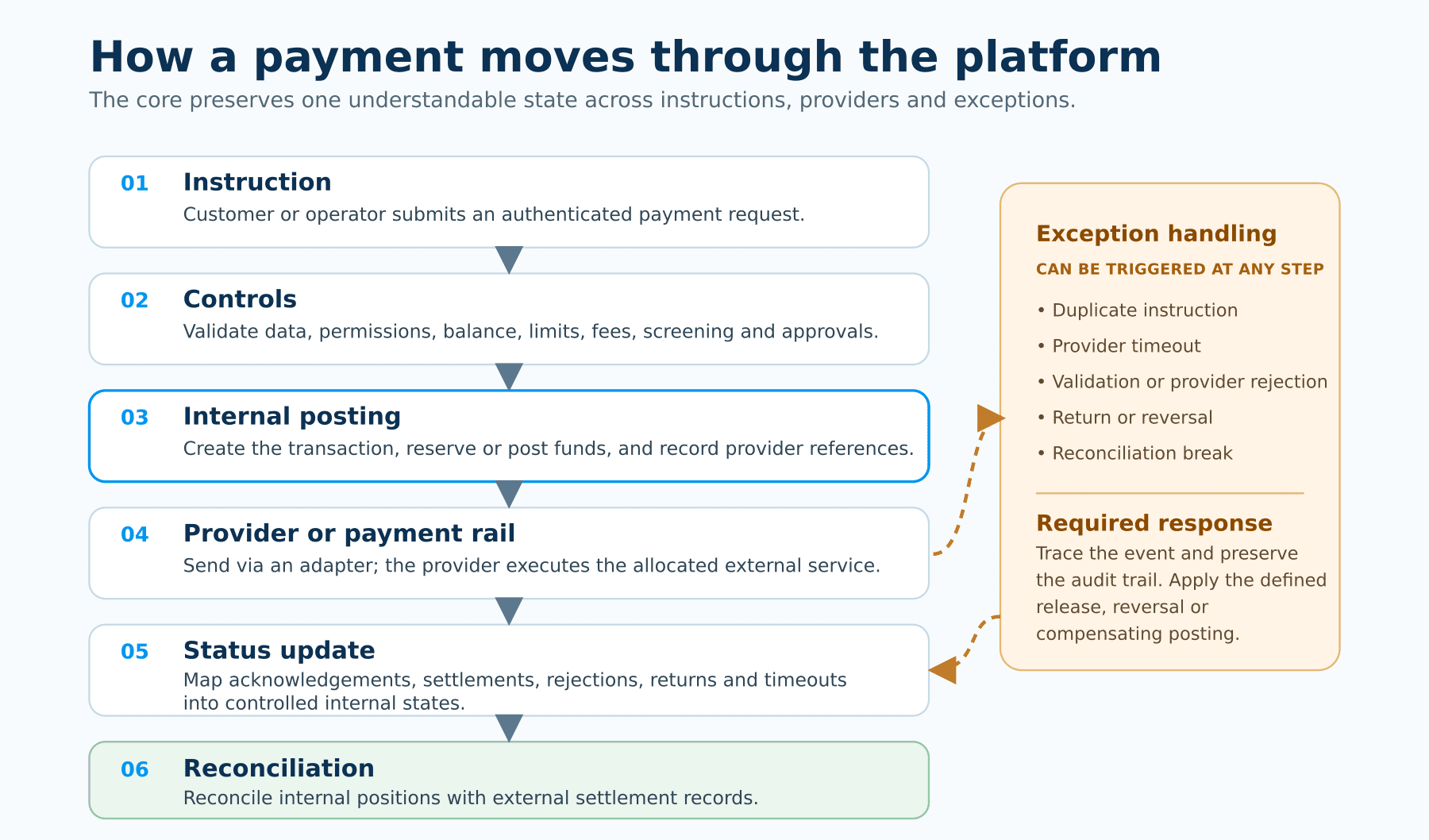
Take an outbound account-to-account payment. The customer or operator creates the instruction through an authorised channel. The platform validates the account, currency, beneficiary data and available balance, checks limits and calculates the fee. Depending on the model, the payment may require an additional signature, screening, a manual review or another approval.
The core then creates the internal transaction and the appropriate reserved or posted balance effect. It sends a provider-specific message through an adapter. The provider may respond synchronously with an acknowledgement and later send the real execution status by webhook, file or polling. “Accepted by API” must not be confused with “settled to the beneficiary”.
When a final status arrives, the core updates the transaction and ledger position. A rejection may release a reserved amount; a return may require a new compensating transaction; a fee may remain or be reversed according to the product rules. Duplicate messages must not create duplicate postings, which is why idempotency and provider reference mapping are essential.
Reconciliation closes the loop by comparing the core’s position with the provider’s statement or settlement record. Execution timing depends on the provider, rail, cut-off times and exception handling. The core’s responsibility is to preserve an understandable internal state throughout.
Integrations that determine whether the platform works
A core banking platform becomes operational only when it connects to providers that accept the business model, jurisdictions, customer types, currencies, transaction patterns and expected volumes. The existence of an API or a logo on a partner page is not proof that the commercial route will work for a particular fintech.
The provider map normally includes:
- KYC/KYB, sanctions, PEP, AML, transaction-monitoring and fraud services;
- banks, safeguarding or operational account providers and virtual-IBAN infrastructure;
- SEPA, SWIFT, faster-payment and local-payment connectivity;
- card issuers, BIN sponsors and card processors;
- FX, liquidity and treasury providers;
- crypto custody, wallet infrastructure, exchange and KYT services where relevant; and
- accounting, data warehouse, CRM, notification and regulatory-reporting tools.
Provider due diligence should happen before implementation is treated as a fixed schedule. A provider may reject the customer segment, corridor or product even though its API supports the requested message. Commercial onboarding, compliance approval, production credentials and settlement arrangements are separate from technical integration.
The technical review should compare the sandbox with production. Are all required fields available? Do production webhooks behave the same way? How are retries, rate limits, timeouts and duplicate messages handled? Which party maps provider statuses to the core? Are reconciliation statements or files available, and who investigates a break? What happens outside support hours?
Portability improves when the core uses stable internal definitions for accounts, payments, cards and statuses, while provider-specific logic remains in adapters. Replacing a bank or processor will still be a project, but the institution should not need to redesign its ledger or every customer channel. Ask to see core banking APIs and provider integrations in operation, not only a list of endpoints.
Provider examples should be treated as examples. Advapay’s technology partner marketplace shows the types of KYC, payment, card, banking and other services that can be connected, but provider acceptance and the availability of a maintained adapter must be confirmed for each project.
Integration readiness checklist
- Commercial and compliance acceptance for the intended model
- Production API coverage, credentials and rate limits
- Field, currency and status mapping
- Webhooks, polling and file-based updates
- Retry, timeout and duplicate-message handling
- Reconciliation data and investigation ownership
- Sandbox and production parity
- Support contacts, incident escalation and change notification
- Exit, data export and replacement-provider plan
Implementation, replacement and go-live
A standard core implementation can often be planned over two to three months once requirements, scope and external providers are settled. Full card, crypto, mobile, migration or multi-provider programmes commonly require six months or more. These are planning ranges, not delivery promises.
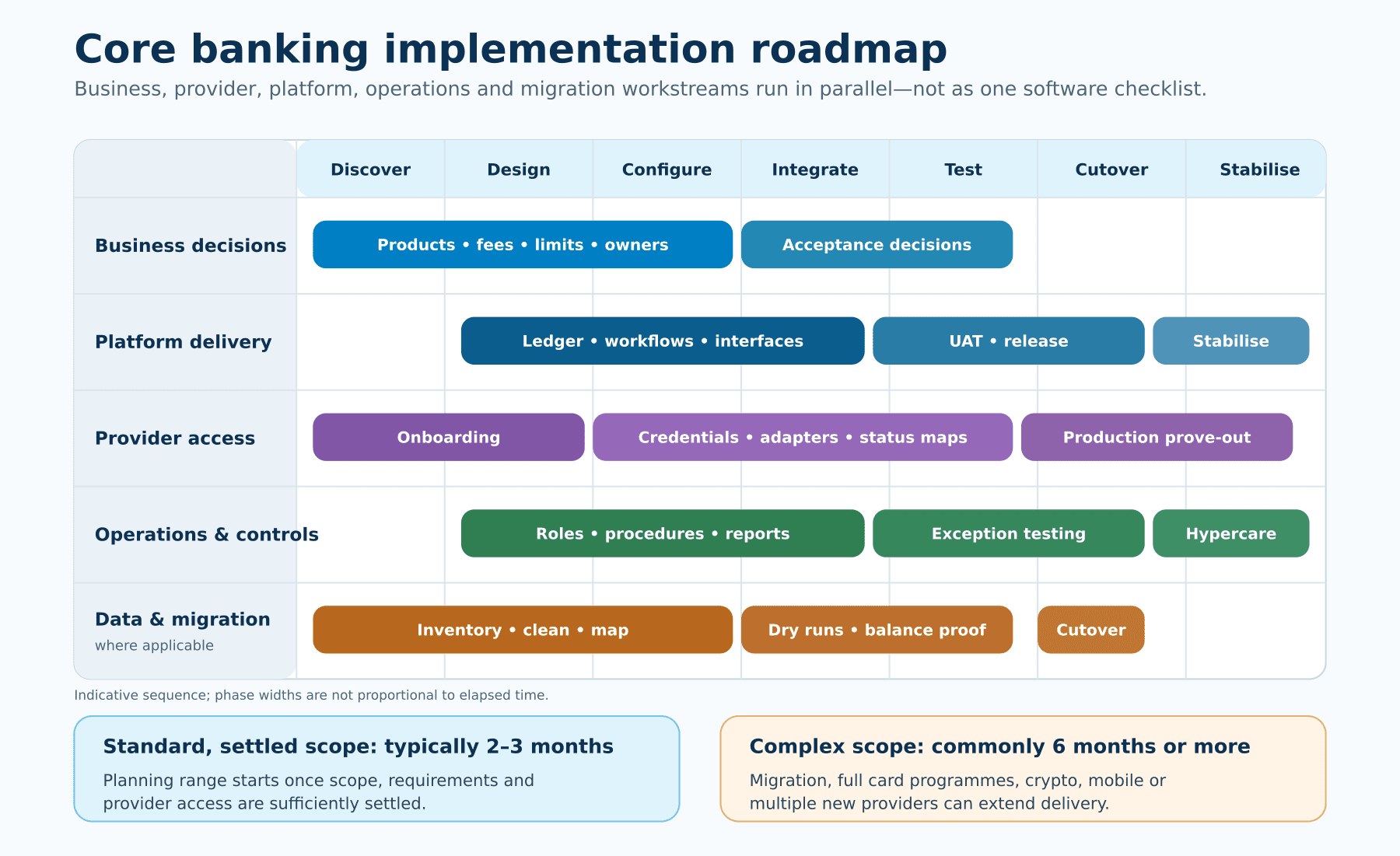
The work should be organised as one programme with several parallel tracks.
Discovery and operating design. Define customers, products, currencies, accounts, transaction types, fees, limits, approvals, provider roles, reports and exception procedures. A platform cannot compensate for an unclear product model. The client’s minimum responsibility is to know what it is building, provide understandable guidance, prioritise decisions and approve the resulting configuration.
Product and ledger configuration. Configure customer groups, account structures, IBAN logic, tariffs, transaction workflows, chart of accounts, posting rules, access roles and reports. Each rule needs an owner and testable acceptance criterion.
Provider onboarding and integrations. Complete commercial onboarding, obtain production access, map data and statuses, implement or configure adapters and define reconciliation. Provider delays are one of the most common reasons a “software timeline” ceases to be a programme timeline.
Compliance and operational readiness. Connect onboarding, screening and monitoring services; define manual reviews; establish account restrictions, four-eyes controls, customer support, incident escalation and daily/period procedures. Train operators on normal activity and exceptions.
Migration, when replacing a core. Inventory products, customers, accounts, balances, open transactions, mandates, beneficiaries, documents and history. Clean and map the data. Prove opening balances and run parallel reconciliation before cutover. Decide which history is migrated, archived or made available through a separate view. Prepare rollback criteria rather than assuming the cutover cannot fail.
Testing and acceptance. User acceptance testing must cover more than happy paths. Test incomplete onboarding, manual approvals, insufficient funds, duplicate instructions, delayed provider statuses, failed and returned payments, fee reversals, restricted accounts, reconciliation differences, provider downtime and permission boundaries. Operational acceptance should confirm that staff can identify, explain and resolve an exception.
Cutover and stabilisation. Freeze the agreed data, execute the migration or production activation, verify balances and integrations, and monitor the first operating cycles closely. Establish who can make emergency decisions, how defects are prioritised and what constitutes a rollback or service restriction.
High-end internal engineering expertise is not required for every standard vendor-led implementation. The client does, however, need available decision-makers, provider access, data ownership, operational staff and enough technical coordination to give the delivery team clear tasks. A CTO replacing a legacy core will carry a larger internal burden because data mapping, coexistence and cutover risk remain with the institution.
How to choose a core banking platform
Choose a platform by testing whether it can represent the business model accurately, keep its ledger and external positions reconcilable, support the required providers and exceptions, fit the intended deployment model and be implemented by a team that can evidence its claims. A polished demonstration is the start of due diligence, not the conclusion.
Give vendors the same realistic scenarios. For a launch-stage fintech, ask them to configure a customer type, multi-currency account, fee, payment limit, approval rule and external provider. For a replacement project, add migrated balances, open transactions, legacy identifiers, a provider timeout and a reconciliation difference. Observe what the operator can see and change without a developer.
| Criterion | Evidence to request | Primary owner | Red flags |
|---|---|---|---|
| Business-model fit | Configured demonstration using your customers, products, currencies, fees and restrictions | Product/operations | Generic demo with no explanation of configuration limits |
| Ledger and accounting | Posting examples, balance logic, chart of accounts, period procedures and reconciliation output | Finance/technology | Balances shown without traceable double-entry or exception handling |
| Operational tooling | Operator queues, audit history, permissions, manual actions, reporting and exports | Operations/compliance | Every exception requires database access or vendor intervention |
| APIs and integrations | Current API documentation, webhook model, adapter inventory, production references and status mapping | Technology | “API-first” claim without production error and retry behaviour |
| Security and access | Authentication, MFA, roles, audit trails, encryption, vulnerability process and evidence relevant to your controls | Security/risk | Certification language without scope, evidence or current applicability |
| Resilience | Reference architecture, monitoring, backup, recovery tests, incident process and service responsibilities | Technology/risk | Availability promise without recovery design or named operating owner |
| Deployment and ownership | Responsibility matrix for SaaS, licence or source-code model; upgrade and release policy | Technology/procurement | “Full control” without maintenance, support and dependency obligations |
| Migration | Data model, mapping approach, reconciliation, cutover plan, rollback criteria and prior migration evidence | Technology/operations | Timeline excludes data quality, history and parallel balance proof |
| Delivery capability | Named team, implementation plan, dependencies, governance, acceptance gates and reference customer | Programme owner | Fixed go-live date before scope and providers are agreed |
| Support and roadmap | SLA, escalation model, support hours, release notes, deprecation policy and roadmap governance | Operations/technology | Important functionality exists only as an undated roadmap item |
| Vendor viability | Ownership, financial stability, customer base, key-person dependency and exit provisions | Executive/procurement | No practical data export, transition support or continuity plan |
Security evaluation should be evidence-based. Frameworks such as NIST CSF can help structure governance, protection, detection, response and recovery questions, while regulated entities must map the service to their own legal and supervisory obligations. A vendor should explain its controls and the customer’s responsibilities without presenting the software as “regulator approved” or automatically compliant.
Core banking pricing depends on the commercial and operating model: SaaS or licence, environments, modules, web and mobile channels, integrations, migration, custom work, hosting, support and third-party providers. Compare total responsibility and cost over a realistic period, not only the initial licence line. See what determines core banking software cost and the build-or-buy framework for deeper analysis.
Where Macrobank fits
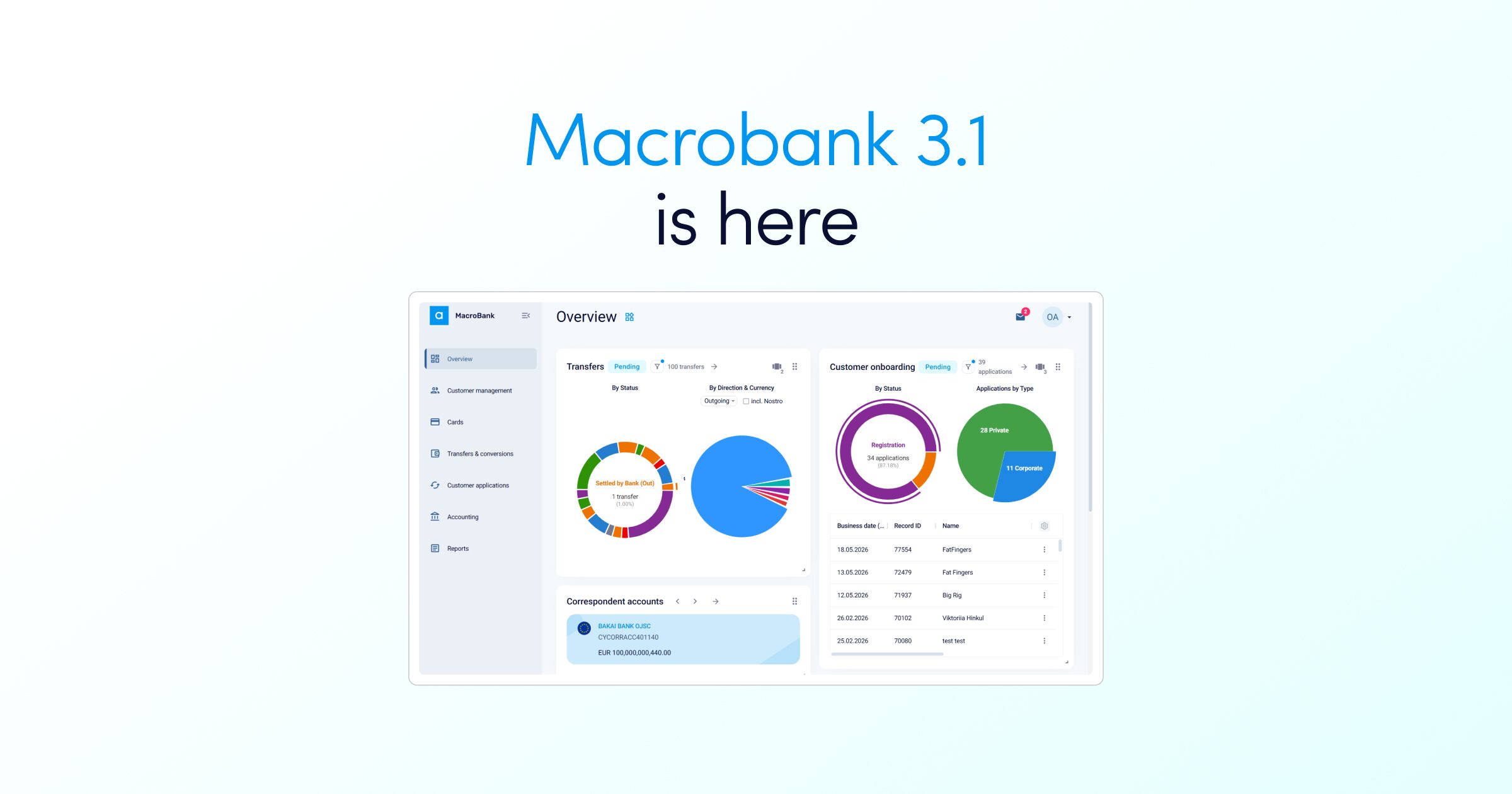
Macrobank is Advapay’s configurable core banking platform for payment and electronic money institutions, fintechs and related financial-service models. It is available as SaaS, under a perpetual licence for customer-controlled deployment, or through a source-code purchase. The appropriate model depends on how much infrastructure, release and engineering responsibility the client wants to own.
The platform combines customer and account management, multi-currency accounts and IBANs, payments and transfers, tariffs and fees, currencies and FX, financial accounting and general ledger, reporting, fiat reconciliation, role-based operator access and customer-facing web or mobile channels. Optional modules extend the platform to cards and crypto-fiat operations. Compliance and payment services can be connected through provider integrations rather than being presented as automatically native.
Macrobank’s card module supports the operational card lifecycle: physical or virtual card ordering, activation, block and unblock, closure, renewal and replacement, account funding movements, transaction and authorisation history, statements and reconciliation. An integrated issuer and processor still perform card processing and scheme connectivity.
The platform uses modular domain logic, REST APIs and separate customer, operator and integration components. Current public product material describes a .NET 10 platform, React with TypeScript as the target modular web stack, Angular in the current customer frontend, Apache Ignite for distributed caching, RabbitMQ for event-driven messaging, OpenTelemetry for observability and a Kubernetes-ready deployment model. The point is not the technology list itself. It is the operational result: a controlled ledger, configurable workflows, traceable interfaces and provider positions that can be reconciled.
For a standard settled scope, Advapay typically plans implementation over two to three months. A programme involving migration, full cards, crypto, mobile applications or multiple new integrations should be planned on a longer horizon, commonly six months or more. The client does not need to supply a high-end platform-engineering team for standard delivery, but it must provide a clear product model, prioritised requirements, provider access, timely approvals, data and operational owners.
Advapay has supported more than 150 fintech projects. Approximately 50 active fintech clients currently use the platform, supported by a team of more than 70 people across seven offices in Amsterdam, London, Tallinn, Belgrade, Toronto, Madrid and Warsaw.
How European SecurePay Center uses Macrobank behind PayoNet
European Securepay Center, s.r.o. is a Czech small payment institution supervised by the Czech National Bank. Its published terms identify PayoNet as the brand owned and operated by European Securepay Center and describe a system offering multi-currency accounts, transfers, management and payment services.
Macrobank provides the core operating layer behind PayoNet’s account and transaction infrastructure. In this structure, European Securepay Center remains the regulated service provider, PayoNet is the customer proposition and brand, Macrobank supplies the core account, transaction and operational record, and connected financial-service providers perform the external services allocated to them.
The example is useful because it shows what a core banking implementation should achieve without overstating the software’s role. The platform does not replace the regulated entity or the external payment infrastructure. It gives the operator a configurable account and ledger foundation on which the customer proposition and provider connections can run. European Securepay Center could therefore operate PayoNet as an account-based payment service without first building the core layer from zero.
Explore Macrobank core banking software or use the options below to discuss a launch or replacement project.
Frequently asked questions
What is the difference between core banking software and digital banking software?
Core banking software keeps the controlled customer, account, balance, ledger and transaction record. Digital banking software presents that record and the available services through web, mobile or operator channels. The products may be sold together, but the interface should not become an independent financial source of truth.
Does a core banking platform include payment processing?
It usually includes payment initiation, validation, fees, approvals, ledger postings, status tracking and reconciliation. An external bank, payment provider, processor or rail commonly executes the actual payment. The boundary must be explicit so an API acknowledgement is not mistaken for final settlement.
Which modules should a fintech core banking system include?
Most payment-focused fintechs need customer and account management, a double-entry ledger, payments, fees and limits, accounting and reconciliation, reporting, permissions and integrations. Cards, mobile applications, crypto, lending or other capabilities depend on the product. KYC, screening and transaction monitoring may be connected specialist services.
Is cloud core banking better than on-premise software?
Neither model is automatically better. SaaS can reduce infrastructure work and simplify standard upgrades; customer-controlled deployment can provide more environmental and release control. Compare security responsibilities, recovery, skills, customisation, portability, support and total cost rather than treating hosting location as a quality measure.
How long does core banking implementation take?
A settled standard implementation may be planned over two to three months. New providers, custom integrations, full card or crypto scope, mobile channels, data migration and complex acceptance testing commonly extend the programme to six months or more. The timeline starts with agreed scope and available provider access, not contract signature alone.
What determines the cost of core banking software?
Cost depends on the SaaS, licence or source-code model; environments; required modules; customer channels; integrations; migration; custom development; hosting; support and third-party providers. Compare the ongoing operating and maintenance responsibility as well as the initial price. Exact vendor pricing requires a defined scope.
Can a fintech replace a legacy core without a big-bang migration?
Yes. A phased migration can move selected products, customers or processes while the legacy platform remains temporarily active. It requires clear ownership of each record, stable interfaces, balance proof and parallel reconciliation. Some tightly coupled products may still require a coordinated cutover, so the strategy must follow the data and dependency map.
How much technical expertise does the client need to implement Macrobank?
For a standard vendor-led implementation, the client does not need a large platform-engineering team. It must understand the business it is building, give clear requirements, provide provider access and data, make timely decisions and assign product, operations, compliance and technical owners. Replacement and source-code projects require greater internal capability.