



Advapay digital banking solutions guide
Digital banking solutions are the customer-facing and operational applications that let people and businesses open and use financial products through web, mobile and connected digital channels. A complete solution can cover onboarding, account access, balances and statements, payments, beneficiaries, currency exchange, cards, notifications, support and the operator workflows behind those journeys. It normally connects to a controlled core banking layer and to specialist external providers rather than replacing every system in the financial stack.
For a fintech founder, the practical question is not whether an application looks modern. It is whether the digital experience can be operated safely and consistently once real customers, payments, exceptions and provider dependencies appear. For an established institution, the question is whether new channels can be changed without turning every front-end release into a core-banking project.
That distinction is important because the terms digital banking, digital banking platform and digital core banking are often used as if they meant the same thing. They do not. This guide focuses on the experience and channel layer: what users and staff interact with, what capabilities it should expose, how it connects to the core and providers, and how to evaluate digital banking software without confusing the interface with the system of record beneath it.
Digital banking solutions at a glance
- Customer channels. Branded web and mobile experiences for individuals, businesses and other customer types.
- Digital onboarding. Registration, data capture, document collection, verification steps and hand-off to operational review.
- Accounts and payments. Balances, statements, beneficiaries, transfers, payment signing, currencies and transaction history.
- Cards and add-ons. Card ordering and lifecycle functions, where included, plus optional services connected through providers.
- Operator experience. Back-office tools for customer servicing, approvals, exceptions, permissions, support and operational evidence.
- Connected controls. Authentication, APIs, core-banking state and specialist providers coordinated behind the customer journey.
Scope note: This page owns the search intent around digital banking solutions, digital banking platform, digital banking software and related online/mobile banking terms. If you need the back-end operating and system-of-record layer, read Digital Core Banking for Fintechs Explained. For the broader core-banking category, architecture and selection framework, use the core banking software guide.
1. What is a digital banking solution?
A digital banking solution is the software experience through which customers and staff access, initiate and manage financial services digitally. It can include a web application, mobile application, onboarding journeys, self-service account and payment functions, card controls, notifications, support features and the operator interfaces used to review or service those activities.
The most important word is experience. Digital banking software presents financial products and workflows to a user, but it should not create a second financial truth. A customer can see a balance on a mobile screen, create a beneficiary and submit a transfer. The authoritative account state, posting logic, fees, limits and transaction record should still come from the controlled operating layer underneath. External providers may execute identity checks, card processing or payment-rail activity. The digital channel coordinates those capabilities into one usable journey.
This makes a modern digital banking platform more than a collection of screens. It has to translate customer intent into valid instructions, retrieve reliable state from underlying systems, handle intermediate statuses, apply the right authentication or signing step, present errors intelligibly and give operators enough context to resolve exceptions.
Online banking and mobile banking are channels, not separate operating models
Online banking usually refers to browser-based access. Mobile banking refers to an app or mobile-first experience. They can expose many of the same services: onboarding, account details, transaction history, payments, beneficiary management, currency exchange and support. A strong digital banking solution keeps the financial rules consistent across those channels while allowing the interface and journey design to suit the device.
For a business customer, the channel may also need multi-user access, approval schemes, payment signing and mass-payment workflows. A retail or wallet proposition may prioritize fast onboarding, cards, transfers and self-service support. The experience changes; the controlled financial state should not.
Digital banking is not simply “banking on an app”
An app can be beautifully designed and still be operationally weak. The real test appears after launch: what happens when a payment is pending, a provider is unavailable, a user has insufficient permissions, an account is restricted, a verification result needs review or a customer disputes what the interface shows? The digital solution must surface the right state and route the right action rather than hide operational complexity behind a polished front end.
That is why founders should define digital banking requirements as customer journeys plus operating responsibilities. “We need an app” is not a sufficient specification. “A corporate customer must register, pass required verification, receive an account, add users, configure signing rights, create a SEPA payment and let two authorised users approve it” is the beginning of one.
2. Digital banking vs digital core banking vs BaaS
These three concepts can appear in the same fintech proposition, but they solve different problems.
| Layer | Primary job | What it still depends on |
|---|---|---|
| Digital banking solution | Presents customer and staff journeys through web, mobile and other interfaces | Core/platform APIs, identity and provider integrations, permissions and product configuration |
| Digital core banking | Maintains the controlled product, account, balance, transaction and ledger state and applies operating rules | Regulated permissions, banking access, payment rails, card/KYC/FX and other external services |
| Banking-as-a-Service | Supplies regulated or financial capabilities through a provider relationship | Provider contract, permissions, risk appetite, technical integration and the customer-facing proposition |
The distinction prevents two common mistakes.
The first is buying a front end and assuming the operating core has been solved. A mobile app can submit a transfer, but something must still validate the account, apply limits and fees, track the transaction state and reconcile the result. The second is buying a core and assuming the customer experience has been solved. A strong ledger does not automatically create an intuitive onboarding journey, a branded mobile experience or a usable business-banking approval flow.
BaaS adds another layer. A BaaS provider may supply accounts, payments, cards or other regulated capabilities under a defined commercial and compliance relationship. Those services can be exposed through your digital banking solution and coordinated by your operating platform. They do not remove the need to decide which system owns the customer experience, product configuration, internal records and operational exceptions.
If you are evaluating the back-end layer itself, see the dedicated digital core banking explainer. If your main question is access to external financial capabilities, see Advapay’s Banking-as-a-Service marketplace.
3. Who needs a digital banking solution?
Digital banking software is useful wherever a financial proposition needs to turn accounts, payments or other financial capabilities into a coherent experience for customers and staff. The underlying products may be similar, but the digital journeys can be very different. A platform that works for an individual wallet is not automatically suitable for a business-account proposition with multiple users and payment approvals.
This is why platform selection should begin with the operating model and customer population rather than a generic list of features. The same underlying technology can support several propositions, but only if customer roles, workflows, product visibility and external-provider responsibilities can be configured without creating a separate architecture for every new use case.
EMIs, payment institutions and PSPs
An EMI, PI or PSP may need to give customers access to payment accounts or wallets, balances, statements, transfers, beneficiaries, FX, cards and support while keeping the operator team in control of onboarding, permissions, payment exceptions and service requests. The digital banking layer becomes the place where the regulated proposition is experienced, but it still depends on the institution’s permissions, operating procedures, banking access and specialist providers.
For a new regulated fintech, the practical advantage of an established platform is that common journeys and back-office functions do not have to be invented independently. The implementation can focus on configuring the proposition, integrating the required providers and defining the parts that genuinely differentiate the business.
Neobanks and digital-first financial propositions
A neobank or digital-first proposition puts more pressure on the customer experience because the web or mobile channel may be the primary relationship with the customer. Fast onboarding, clear account status, intuitive payments, card controls, notifications and self-service become part of the product itself rather than a secondary channel.
That does not make the underlying operational model less important. The more seamless the front end appears, the more carefully the platform needs to handle pending states, provider failures, account restrictions, additional verification and other situations that interrupt the ideal journey.
Business and corporate banking propositions
Business users often introduce requirements that consumer-focused platforms underestimate: several users within one organisation, differentiated permissions, preparer-and-approver roles, payment signing, templates, bulk actions and clearer audit history. The digital solution also needs to represent companies, their authorised persons and their accounts without collapsing everything into a single-user model.
For these propositions, operator tooling and permission design are as important as the customer interface. A good-looking business portal is not enough if support staff cannot explain who created an instruction, who approved it and why it is waiting for action.
Established institutions modernising digital channels
An established payment company or financial institution may already have a functioning core, provider estate and customer base. Its problem is different: replace or improve the digital experience without destabilising the financial record underneath it. In that scenario, API coverage, migration strategy, coexistence and the ability to introduce new journeys progressively matter more than the speed of a greenfield launch.
The selection question therefore becomes: can the proposed digital banking platform sit cleanly above the systems that should remain, while giving product teams a more adaptable channel layer? If the answer requires recreating core financial logic inside the front end, the modernisation has simply moved the legacy problem rather than solved it.
4. What a digital banking platform should include
There is no universal feature checklist that every fintech needs. The right scope follows the customer type, licence or sponsor model, target markets, currencies, payment rails, card programme and operational responsibilities. Still, most serious digital banking solutions are assembled from a familiar set of capability groups.
Digital onboarding
Onboarding is the first operational journey, not just a registration form. A solution may need private and corporate registration, contact verification, document capture, related-person or company-official data, terms and consents, KYC/KYB provider steps and hand-off to an operator when automated processing cannot decide the case.
The customer experience should make the status clear without pretending the channel itself has made a compliance decision that belongs elsewhere. The operator side should preserve enough context to review, request information, approve, reject or route the case according to the institution’s procedures.
Accounts, balances and statements
Customers typically need a clear view of available accounts or wallets, currencies, account details, balances, statements and transaction history. Where the proposition supports several accounts or currencies, the navigation needs to remain understandable as the product grows.
The digital channel should read those values from controlled sources. It should not independently calculate a final balance or reconstruct an authoritative statement from incomplete provider events.
Payments, beneficiaries and signing
Payment journeys can include own-account transfers, internal transfers, SEPA, international payments, templates, drafts, beneficiaries and mass-payment files. Business customers may need several signatories or different approval permissions. The interface must therefore handle more than “send money”: it must show who can initiate, who can approve, what status the instruction has reached and what action is available next.
Currency exchange
If FX is part of the proposition, digital banking may expose available currencies, quotes or configured rates, exchange instructions and resulting transaction history. Execution may still depend on a bank, liquidity or FX provider. The channel should present the service while the operating platform preserves the financial record and provider boundary.
Cards
Where cards are in scope, useful customer functions can extend well beyond “show my card”. Depending on the issuer/processor integration and the configured product, a platform may support ordering, viewing card details, activation, blocking and unblocking, closure, replacement or renewal, statements and transaction or authorisation history.
Cards are a good example of why product boundaries matter. The digital banking application presents lifecycle actions, the core can maintain the product relationship and internal records, and an issuer/processor remains responsible for the external card service defined by the programme.
Notifications and support
Digital banking should not become silent when something needs attention. Notifications can surface new messages, requests, payment events or required actions. Secure internal messaging or service requests can give customers a traceable path to the operator team instead of forcing every issue into email.
Operator and administration tools
The customer app is only half the solution. Staff need tools to view customers, accounts, payment instructions, documents, permissions, tariffs, reports, statuses and exceptions. Administrative tooling may also maintain roles, access levels, workflow configuration, currency settings and other controlled parameters.
This is the operational difference between a demo and a deployable proposition: someone must be able to understand and act on what the customer has done.
5. How digital banking connects to the core and providers
The cleanest architecture keeps the customer experience, controlled financial state and specialist services separate but connected.
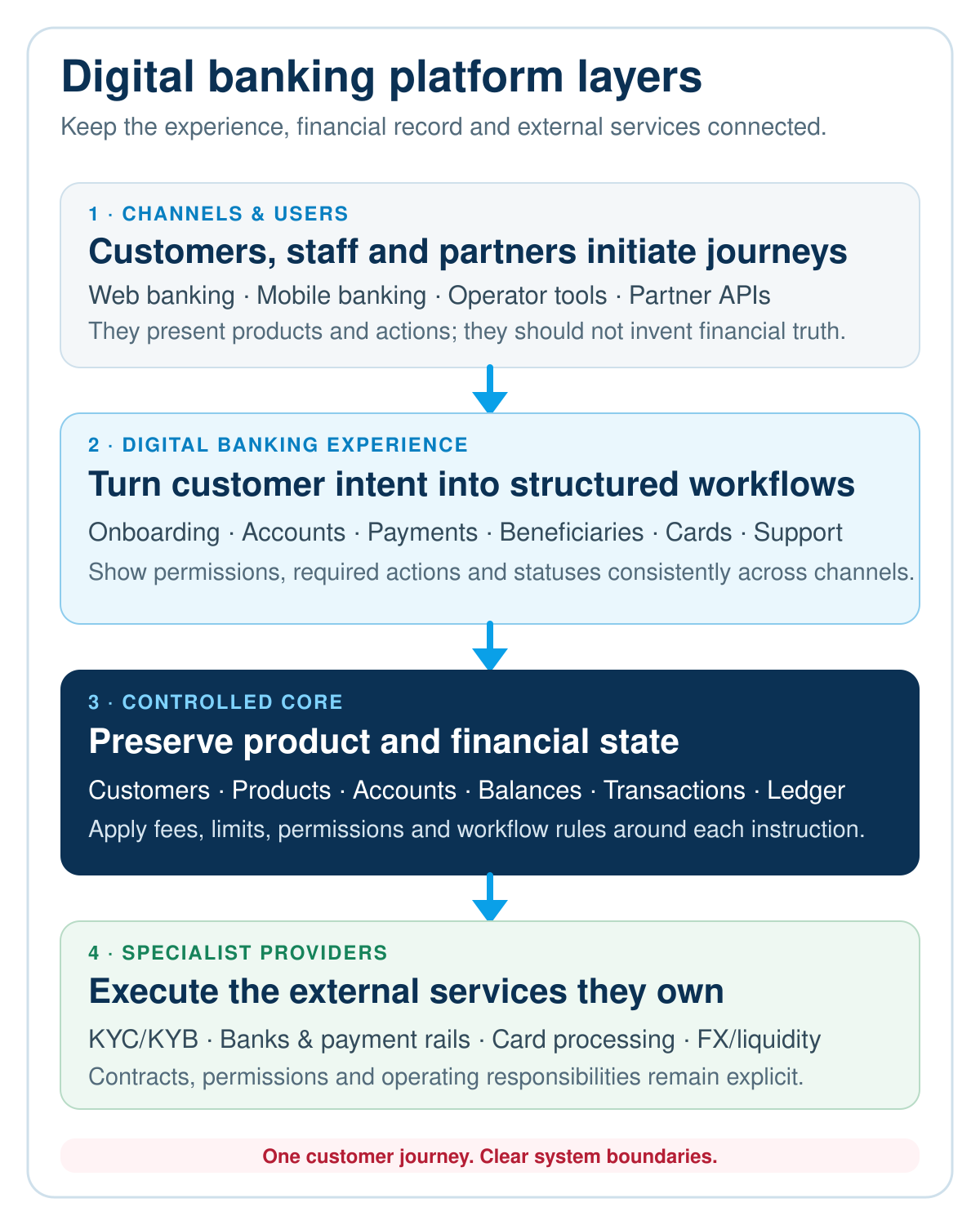
Customer and partner channels capture intent. A user signs in, opens an account screen, submits onboarding data, creates a beneficiary, initiates a payment or manages a card. An operator can perform a related action through back-office tooling, and a partner can submit permitted instructions through an API.
The digital banking experience layer presents journeys, validations and statuses. It should know what the user is allowed to do and what information to request, but it should rely on the underlying operating platform for authoritative product and financial state.
The controlled core maintains customers, products, accounts, balances, transaction states and ledger records; it applies configured fees, limits, permissions and workflow rules. It also coordinates the internal state of instructions that are handed to external providers.
Specialist providers perform functions such as identity verification, bank or payment-rail execution, card processing, FX/liquidity or other services. The exact providers and legal responsibilities depend on the proposition.
The architecture matters because each layer changes at a different pace. Customer journeys and branding may change frequently. Providers can be replaced or added as the business expands. The core financial record needs to remain consistent throughout those changes.
One customer action can cross several systems
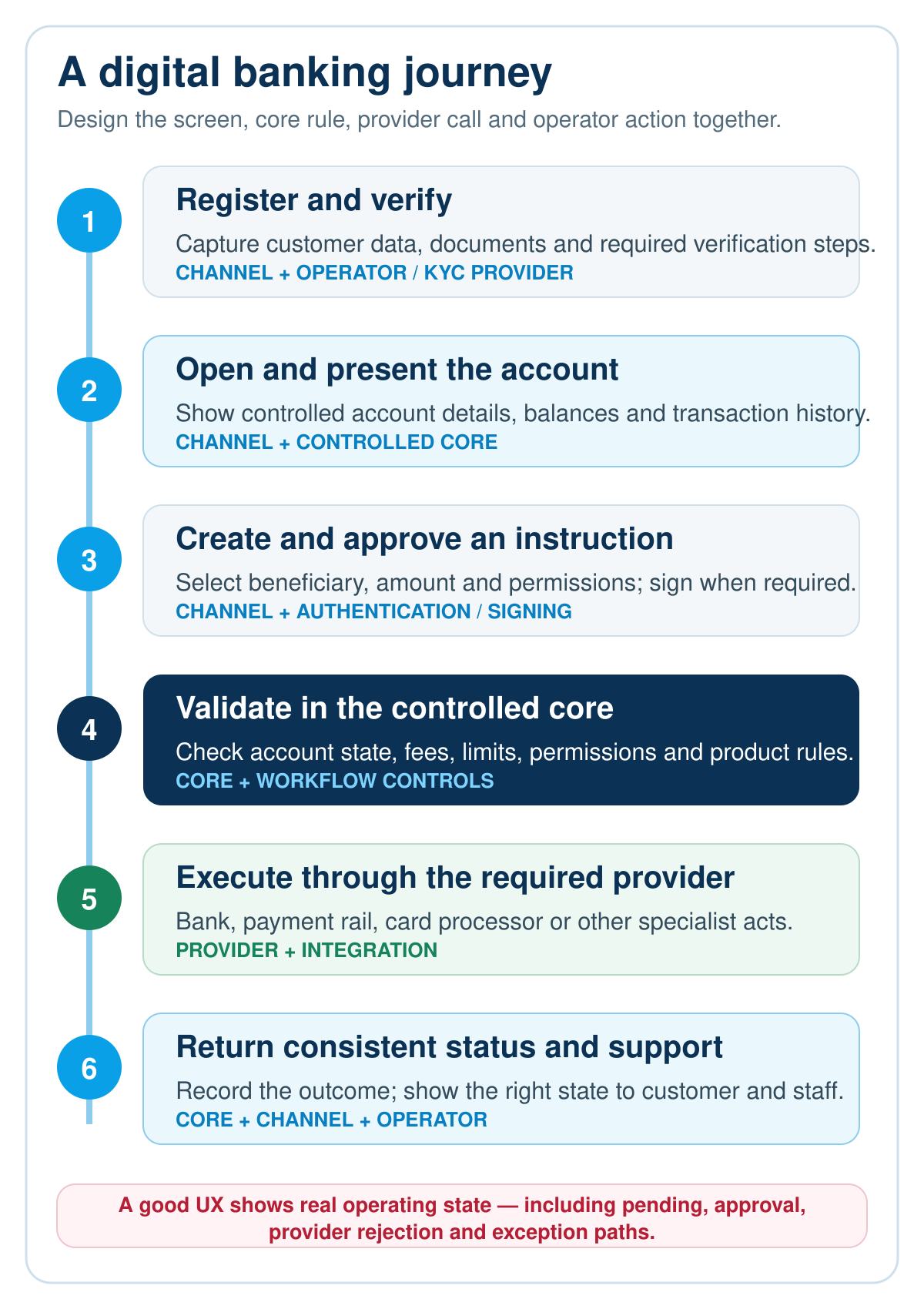
Consider a payment submitted from mobile banking. The user chooses an account and beneficiary, enters the payment data and confirms the instruction. The channel sends a structured request. The operating layer checks the account state, permissions, limits, fees and product rules. If the payment requires a bank or rail, an integration sends the relevant instruction to that provider. Statuses come back. The platform records the evolving internal state and exposes the right result to the customer and operator.
This sequence is why digital banking UX cannot be designed in isolation. “Pending”, “requires approval”, “rejected by provider” and “completed” are not cosmetic labels. They reflect real states and responsibilities that need to be defined before the screens are finalised.
6. Essential digital banking capabilities
Feature quantity is a poor way to compare digital banking platforms. A better test is whether the platform can support the journeys your business actually intends to operate and whether staff can control those journeys after launch.
Customer journey coverage
Start with end-to-end use cases. Can an individual or business register, become an approved customer, access an account, fund it, make the required payment types, manage beneficiaries, obtain support and understand the status of every important action? If cards are part of the proposition, can the customer manage the relevant lifecycle in the same experience?
Avoid assessing each screen as an isolated feature. A payment function is not complete if the operator cannot investigate a failed payment or the customer cannot understand that another signatory must approve it.
Configurability and branding
White-label delivery matters because the experience should belong to your proposition, not look like a generic vendor demo. Branding is the visible layer, but configurability also needs to cover product-relevant fields, permissions, menus, supported journeys and what each customer type can see.
The deeper question is governance: which changes can business or product teams configure safely, which require the software vendor, and which require development? That answer determines how quickly the proposition can evolve after launch.
Business-banking permissions and signing
Corporate customers can require multiple users, different access rights and approval or signature schemes. A platform intended for business banking should model those responsibilities explicitly. A single-user consumer wallet pattern does not automatically scale into a multi-user corporate account experience.
Operator visibility
Every customer-facing capability needs an operational counterpart. Staff should be able to understand the customer, account, payment, document, permission and status context relevant to their role. Audit and event history should make it possible to answer “what happened?” without relying on screenshots from the customer.
Consistent multichannel behaviour
Web and mobile do not need identical interfaces. They do need consistent financial meaning. A balance, beneficiary, payment status or account restriction should not acquire a different truth because the customer changed device.
Accessible integration boundaries
A digital banking platform should make clear which functions come from the platform, which come from the controlled core and which depend on external providers. This protects the architecture from hidden dependencies and helps procurement teams compare vendor scope accurately.
7. Benefits of a modern digital banking solution
The business case for digital banking software is not simply that customers expect an app. The more important benefit is that customer journeys, staff workflows and the systems behind them can be designed as one operating model. When that model is coherent, the institution can change the experience without losing control of the financial state or forcing operators to bridge gaps manually.
Faster route from proposition to usable service
For a greenfield fintech, established channel components can remove a large amount of undifferentiated product work. Registration, account views, beneficiary management, payment forms, signing flows, notifications and operator screens are common needs. Reusing proven building blocks allows the implementation team to spend more time on the proposition-specific rules, providers and customer experience that actually determine the launch.
Faster does not mean instant. Providers still need to be contracted and integrated, products configured, operational procedures agreed and the complete journey tested. The benefit is that the project starts from an operating platform rather than from an empty codebase.
Consistency across customer and operator journeys
Many operational problems appear when the customer sees one status while staff see another, or when a mobile journey supports an action that back-office users cannot investigate. A connected digital banking solution reduces that fragmentation by giving channels and operators a common view of the relevant customer, account and transaction state.
Consistency also improves service design. A payment that requires approval can be shown as such to the initiator, exposed to the appropriate approver and visible to the operator team without inventing a different interpretation at each layer.
Easier product and provider change
A well-separated digital layer can make change more manageable. Product teams may alter navigation, wording, onboarding steps or channel presentation without changing ledger logic. Engineering teams may add or replace a specialist provider behind a defined integration boundary without rebuilding every customer screen.
This does not eliminate the cost of change. Provider replacement, new rails and new products still require analysis and testing. The benefit is architectural: change has a defined place to happen instead of being distributed unpredictably through the whole system.
Better operational visibility and control
Digital banking is often evaluated through the customer’s screen, yet a large share of the long-term value sits behind it. Structured operator workflows, permission models, event history and explicit exception states reduce dependence on informal workarounds. They also give support, operations, compliance and finance teams a clearer basis for investigating what happened and deciding what should happen next.
For financial institutions, this is one of the strongest reasons to treat digital banking as a platform rather than a design project. The experience layer should make the business easier to operate as it grows, not merely make the customer interface look newer.
8. Security, authentication and operational controls
Security is not a badge that can be inferred from a modern interface. During selection, ask for evidence of the controls that apply to your deployment and operating model: authentication, permissions, auditability, encryption, logging, monitoring, dependency management, backups, recovery practices, secure development and incident responsibilities.
Advapay does not rely on unnamed formal certifications as a marketing shortcut here. The right approach is to evaluate the specific controls and evidence relevant to the proposed implementation.
Authentication and transaction signing
For payment services within PSD2 scope, strong customer authentication can apply when a payer accesses a payment account online, initiates an electronic payment transaction or performs a remote action that may imply fraud or abuse risk. The European Banking Authority also makes clear that defined exemptions and detailed conditions matter; a generic “two-factor authentication” label is not a complete compliance assessment.
Digital banking software therefore needs to support the authentication and signing model required by the institution and its regulatory context. Depending on the implementation, this can involve passwords, one-time passwords, authenticator/token mechanisms, device or biometric elements and payment-specific approval flows. The exact method should be validated against the applicable requirements and risk model.
Roles and permissions
The customer side and operator side both need controlled access. Consumer, business-owner, finance-user, approver, support-agent and compliance-user roles should not be assumed to have the same permissions. When corporate users require multiple signatures, the digital journey must reflect who can create, approve and view an instruction.
Auditability and exception handling
Operational security is also about traceability. Who changed the customer’s access? Who approved a payment? Which status came from an external provider? Which configuration determined the fee? A serious platform should preserve the evidence required to investigate unexpected behaviour and reconcile systems.
For more detail on Advapay’s security functionality, see the security overview. Regulatory obligations remain dependent on the jurisdiction, licence model and service being provided.
9. APIs, integrations and provider orchestration
APIs are important, but “API-first” is not a buying criterion by itself. What matters is whether the interfaces cover the customer journeys, operational functions and external dependencies your proposition needs.
Channel APIs
Web, mobile and partner channels need defined ways to retrieve customer and account state, submit instructions and receive statuses. Clear interfaces allow the customer experience to evolve without direct access to the underlying financial database or ledger logic.
Provider integrations
External services can include KYC/KYB and screening, banks and payment rails, card issuers/processors, FX/liquidity services, messaging and other specialist capabilities. The digital solution should expose the result of those services in a coherent journey without hiding which provider remains responsible for the external action.
Status and error design
One of the most underappreciated integration requirements is status mapping. External systems do not all describe success, pending states, rejection and errors the same way. Product and engineering teams should agree how provider states map into the customer and operator experience. The goal is to avoid both false certainty and unusable raw provider messages.
Replaceability
Ask what would happen if you changed a KYC provider, sponsor bank, card processor or payment rail. A modular architecture cannot make replacement costless, but it should give the change a defined integration boundary. If provider-specific logic is spread through the front end, replacement becomes much harder.
For the deeper operating-core perspective on APIs, provider boundaries and the system of record, use the digital core banking guide.
10. How to choose digital banking software
The best digital banking platform is not the one with the longest demo script. It is the one that supports your customer journeys, operating responsibilities and provider model with a delivery approach your team can sustain.
| Criterion | Evidence to request | Red flag |
|---|---|---|
| Journey fit | Configured walkthrough using your customer types, payments, permissions and exception cases | Generic demo with no explanation of what is standard, configurable, optional or external |
| Channel and UX fit | Web/mobile coverage, branding approach, responsive behaviour, business-user roles and signing flows | Beautiful front end that cannot explain its source of account/payment state |
| Integration fit | Current API documentation, supported providers, status mapping and a scoped integration plan | “We have APIs” without proof of the endpoints and workflows your project needs |
| Operator fit | Back-office demonstration covering onboarding review, payments, permissions, support and exceptions | Customer journey works only when every case is successful |
| Security evidence | Authentication, roles, audit trails, logging, recovery, change and incident responsibilities | Certification language or broad security claims without scope-specific evidence |
| Delivery capability | Named team, scope, dependencies, acceptance gates and referenceable implementations | Fixed launch promise before journeys, providers and responsibilities are defined |
Start from the proposition, not the vendor catalogue
Write down customer types, target jurisdictions, required accounts, currencies, payment types, cards, user roles, approval schemes, support model and external providers. Then turn the most important combinations into end-to-end journeys.
Ask what is standard, configurable, optional and custom
Two vendors may both say “cards supported” while one includes only a card view and another supports ordering, activation, block/unblock and replacement against a specific processor integration. The same applies to onboarding, payments, FX and notifications. Scope labels matter.
Test exception cases during the demo
Ask to see a payment requiring a second signatory, an onboarding case needing operator review, a failed provider response or a restricted account. Happy-path demonstrations are necessary, but they do not reveal how the platform behaves when operations become real.
Evaluate the staff experience
The operator interface affects daily cost and control. Product teams often spend most selection time on the mobile UI while ignoring the people who will investigate payments, review customers, respond to requests and reconcile exceptions. Include operations and compliance in the selection process early.
Model total ownership, not a single licence line
Commercial comparison should consider delivery model, environment and infrastructure responsibilities, implementation, integrations, optional modules, application distribution, ongoing support, upgrades and the internal team required to operate and change the solution. Exact pricing is proposal-specific; Advapay does not publish a universal number because scope and ownership choices materially change the commercial model.
Turn the evaluation into an RFP that vendors can actually answer
A useful RFP is specific enough that two vendor responses can be compared on the same basis. Instead of asking whether a platform “supports payments”, describe the payment types, currencies, customer roles, approval rules and provider relationships that are in scope. Instead of asking whether APIs exist, ask for the current documentation for the journeys you intend to implement and identify which endpoints are standard today.
The same discipline should be applied to the customer and operator sides. Ask vendors to demonstrate one complete onboarding case, one normal payment, one payment requiring approval and at least one exception. Request a clear boundary between standard functionality, configuration, optional modules, integration work and custom development. Then ask who will own infrastructure, upgrades, monitoring, incident handling and support under the proposed delivery model.
Finally, make dependencies visible. A credible response should state what the vendor needs from your business, sponsor or banking partner, KYC provider, card programme, app-store accounts and internal team. A proposal that looks faster only because client and third-party dependencies have been omitted is not necessarily the faster implementation.
11. What does a digital banking platform cost?
There is no useful universal price for a digital banking platform because two projects described as “digital banking” can differ by an order of magnitude in scope. A web portal for one customer type and two payment methods is a different implementation from a multi-entity proposition with corporate users, native mobile applications, cards, several currencies, multiple banking partners and a migration from legacy systems.
For that reason, Advapay does not publish a single list price for Macrobank on this page. The more useful procurement exercise is to understand which factors drive implementation and ongoing total cost of ownership, then compare proposals using the same assumptions.
Delivery and ownership model
Vendor-operated SaaS, a software licence deployed into a customer-controlled environment and source-code ownership allocate infrastructure, release, maintenance and engineering responsibilities differently. The commercial model should therefore be considered together with the internal team the customer must maintain. A lower software fee does not automatically mean a lower operating cost if it transfers substantial platform responsibility to the buyer.
For the detailed Macrobank ownership options, use the Macrobank commercial page rather than treating this digital-banking guide as the pricing document.
Channels and applications
Web banking, native or packaged mobile applications, operator tooling and partner/API channels create different design, testing and release obligations. Mobile applications also introduce distribution, device and app-store considerations that a browser-only implementation may not have. The relevant question is not simply “is mobile included?” but what application, branding, release and ongoing-update responsibilities are included in the proposed scope.
Modules, customer types and workflow complexity
Private and corporate customers can require different onboarding, permissions and payment behaviour. Cards, FX, crypto-related services, mass payments or complex signing rules add functional and testing scope. Even where the software already contains a module, the project still needs to configure it against the selected product and provider model.
Integrations and provider readiness
Existing supported integrations can reduce delivery effort, but every project still needs to confirm the provider, account model, credentials, environments, certification steps and exact workflow being used. A completely new bank, card processor or specialist provider can add analysis, development and testing. Third-party fees should also be separated from the software-platform price so the buyer can see which costs belong to which supplier.
Migration, environments and operational support
Replacing an existing platform can introduce data mapping, reconciliation, parallel running, cutover and historical-record requirements that do not exist in a greenfield launch. Buyers should also compare the number and purpose of environments, monitoring and support arrangements, release management, upgrade responsibilities and the expected involvement of their own technology and operations teams.
The practical comparison is therefore total ownership over a realistic period, not a single setup or licence number. Put the same customer volumes, modules, providers, environments, support assumptions and internal staffing model behind every proposal. Only then do the commercial differences become meaningful.
12. Implementation and go-live
A digital banking implementation is a product-and-operations programme, not simply a front-end installation. The most reliable sequence starts by freezing what the proposition means operationally and then configuring the experience around it.
1. Define the product and customer journeys
Agree customer types, products, currencies, payment methods, cards, roles, permissions, fees, limits and service flows. Define both normal and exception states. This becomes the shared language for product, operations, compliance and engineering.
2. Confirm the operating model and providers
Identify the regulated entity or sponsor model, bank/payment access, identity/KYC providers, card programme, FX/liquidity services and any other dependencies. Assign an owner to every provider relationship and every internal decision.
3. Configure channels and core behaviour
Set up the required web/mobile experiences, products, workflows, permissions and back-office processes. Agree branding and content while preserving the underlying financial and compliance controls.
4. Build and test integrations
Connect providers and test their normal and error/status paths. Test the whole customer journey, not only individual API calls. Where an external service is not ready, define what can be simulated and what must wait for real provider certification or onboarding.
5. Run operational acceptance
Product testing proves the interface works. Operational acceptance proves the business can run it. Onboarding reviewers, payment operations, customer support, compliance and finance should validate the workflows and evidence they will use after launch.
6. Prepare release and customer operations
Complete migration or initial-data needs, application distribution where relevant, production access, monitoring, support escalation, incident ownership, customer communications and runbooks. A technically deployed channel is not “live” until the operating organisation is ready to own it.
Advapay commonly works with a 2–3 month planning range for a settled standard scope on Macrobank projects. That is a planning reference, not a universal guarantee. New provider integrations, complex card or crypto scope, migration, app-store processes, regulatory dependencies and late product decisions can extend delivery materially.
Common digital banking implementation mistakes
One recurring mistake is finalising the interface before the operating states have been defined. Teams design the successful onboarding or payment journey first and discover later that they have no agreed behaviour for pending reviews, provider timeouts, rejected instructions or a second required approver. Those states should be part of the product design from the beginning.
A second mistake is selecting external providers too late. A bank, payment rail, KYC service or card processor is not a generic box behind the platform. Its APIs, statuses, certification process and commercial or regulatory constraints can affect the customer journey. Provider decisions should therefore be made early enough to inform the scope rather than being treated as an implementation detail at the end.
A third mistake is focusing almost entirely on customer screens. Operators need to review onboarding, investigate payments, answer customer questions, manage permissions and resolve exceptions. If those workflows are designed after the customer application, the business can reach technical go-live with an experience that staff cannot operate efficiently.
Another mistake is confusing a software feature with regulatory sufficiency. A platform can support KYC integration, payment signing, roles, audit history and screening workflows, but the regulated institution remains responsible for determining which controls, providers and procedures satisfy its applicable obligations. The implementation needs input from compliance and operations, not only product and engineering.
Finally, avoid treating launch as the end of the architecture discussion. The proposition will change: new payment rails, providers, customer segments and products will appear. A good implementation leaves clear ownership for configuration, integrations, releases and support so the next change does not require rediscovering how the platform works.
13. Where Macrobank fits
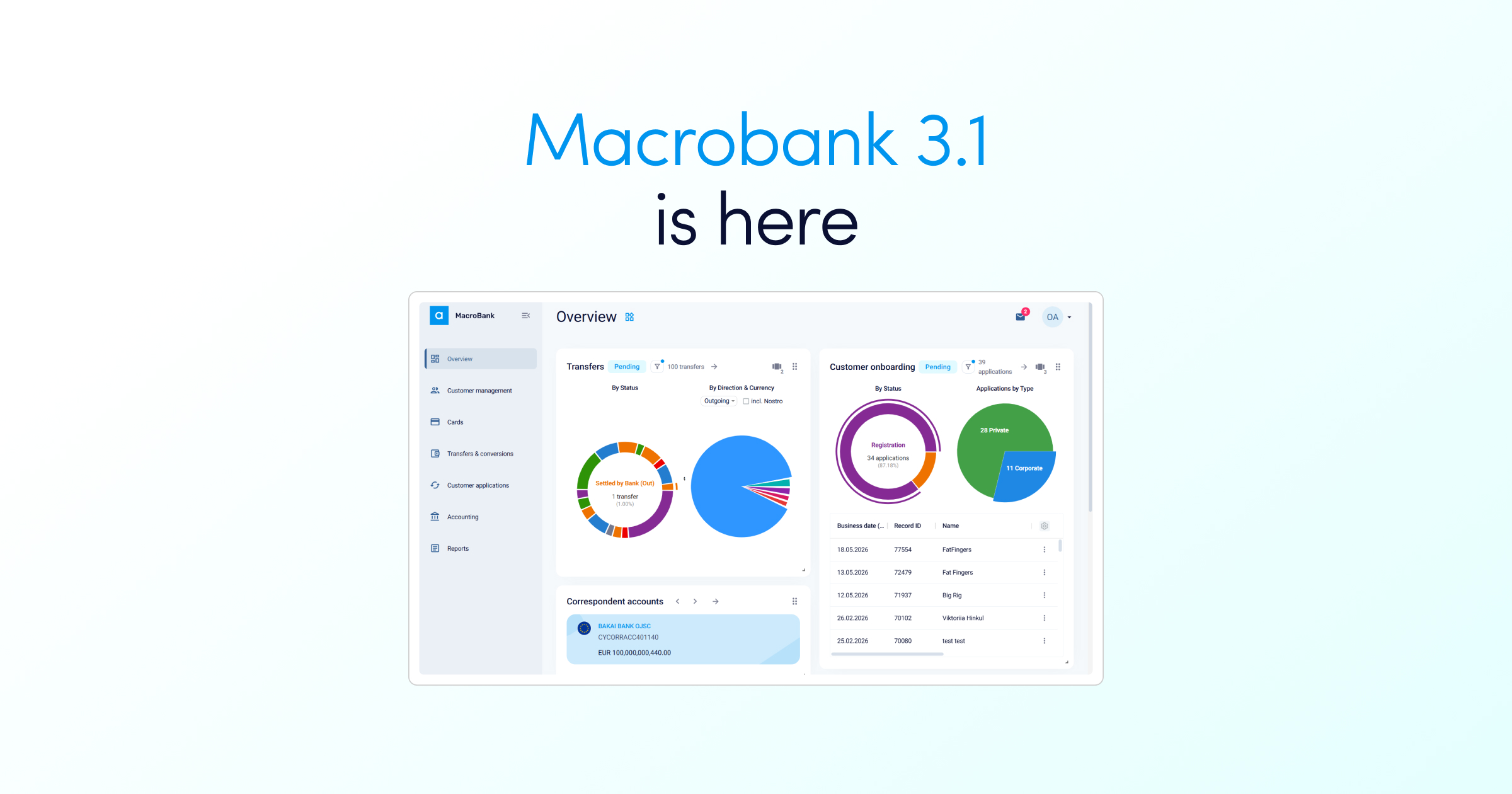
Macrobank is Advapay’s configurable digital banking and payment platform for PSP and financial-service scenarios. It combines the operating core with staff tooling, customer-facing web and mobile channels and integration capabilities, allowing a fintech to assemble the experience and controlled financial layer as one coordinated implementation while keeping external providers explicit.
Current Macrobank product documentation covers private and corporate onboarding, account and wallet views, balances and statements, internal and international payment workflows, beneficiaries, templates and drafts, payment signing, currency exchange, customer messaging, mobile banking and operator tooling. Optional scope can include card and crypto capabilities, with exact availability dependent on the selected package and providers.
Macrobank can be delivered under different ownership models. Advapay’s commercial page describes vendor-operated SaaS, perpetual software licensing in a customer-controlled environment and source-code ownership. The right model depends on how much infrastructure, release and engineering responsibility the customer wants to own.
The key architectural point is the same one used throughout this guide: customer channels present the proposition; the operating core preserves controlled product and financial state; provider integrations perform the external services they own. That separation makes it possible to evolve the customer experience without treating the screen as the ledger.
More than 50 PSPs actively use Macrobank. Advapay can also support the wider launch around the technology, including licensing and banking/payment infrastructure work where required. For detailed product scope, delivery models and implementation boundaries, see Macrobank Core Banking Software for Fintechs and Payment Institutions.
14. Frequently asked questions
What is a digital banking solution?
A digital banking solution is the customer-facing and operational software used to deliver financial services through web, mobile and other digital channels. It can include onboarding, accounts, balances, statements, payments, beneficiaries, cards, notifications, support and operator tools. It normally connects to a controlled core and specialist providers rather than replacing every part of the financial stack.
What is a digital banking platform?
A digital banking platform is the software layer that assembles customer journeys and staff workflows around financial products. A platform may include web and mobile applications, APIs, onboarding and servicing tools, permissions, payment journeys and provider integrations. The term is broader than a single mobile-banking app.
What is the difference between digital banking and digital core banking?
Digital banking is primarily the experience and channel layer through which customers and staff interact with financial services. Digital core banking is the controlled operating and system-of-record layer that maintains products, accounts, balances, transaction states and ledger records and applies configured rules. The two should integrate closely but should not be treated as the same architectural responsibility.
What features should I look for in a digital banking platform?
Start with your actual customer journeys. Typical capabilities include private or corporate onboarding, accounts and balances, statements, payments, beneficiaries, signing and approval flows, currency exchange, cards where required, notifications, customer support, operator tools, permissions, audit history and well-defined APIs. The importance of each feature depends on your proposition.
Is online banking software the same as mobile banking software?
They are different channels that can expose many of the same services. Online banking is normally browser based; mobile banking is normally delivered through a mobile app. A well-designed platform keeps account and transaction meaning consistent across both while adapting the experience to the device.
Does a digital banking solution include KYC and AML?
It can include the onboarding workflow, data collection, operator handling, status presentation and integrations needed for KYC/KYB or screening. The actual verification, screening and compliance decisions may depend on specialist providers and the regulated institution’s procedures. Software capability is not the same as legal or compliance sufficiency.
Can a digital banking platform include cards?
Yes. Depending on the platform, selected module and card-processor or issuer integration, digital banking can expose ordering, activation, blocking, replacement, transaction history and other card-lifecycle actions. Ask vendors to separate what is standard, optional and provider-dependent.
How should a fintech compare digital banking solutions?
Compare configured end-to-end journeys, not feature counts. Test customer and operator flows, permissions and signing, provider integrations, status/error handling, security evidence, branding/configurability, implementation dependencies and the delivery team. Also model ongoing ownership and change costs rather than comparing only a headline licence fee.
How much does a digital banking platform cost?
There is no single meaningful price because cost depends on the delivery model, channels, customer types, modules, provider integrations, migration, environments, support and the internal responsibilities the buyer takes on. Compare proposals using the same scope and a multi-year total-ownership model. Advapay provides Macrobank pricing against a defined project rather than publishing a universal list price on this guide.
How long does digital banking implementation take?
There is no universal duration. Advapay uses a 2–3 month planning range for a settled standard Macrobank scope, but provider readiness, custom integrations, card or crypto requirements, migration, app distribution and regulatory dependencies can extend the programme. A credible timeline should follow a defined scope and dependency map.
Can Advapay provide more than the software?
Yes. Depending on jurisdiction and project scope, Advapay can support fintech licensing, banking access and payment infrastructure alongside Macrobank. Those services remain separate responsibilities and should be scoped explicitly rather than assumed to be automatically included in the software.